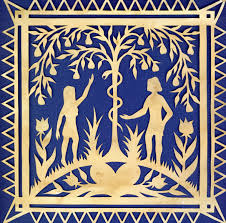
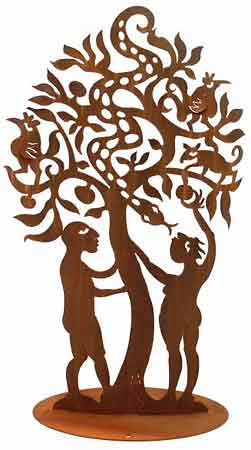
So yesterday, we left young Adam and Eve standing next to the tree of the knowledge of good and evil. As I explained, I was told/shown that the tree was to Adam and Eve what the adult world is to a child. Rather than being a temptation or even a danger, it was a good thing which let them know that there is more to life than their childish existence. God told them not to eat from that tree because the experiences of the adult world are not for children to have – adult experiences being the fruit they were not to eat. Under normal circumstances, the existence and close proximity of the adult world does not pose a threat to children, nor is it particularly tempting. Unless one of the adults does something to bring a child into the adult world inappropriately. Enter the serpent.
It has often been pointed out that the serpent isn’t specifically identified with the character of Satan in this story. However, the serpent was indeed Satan (whatever or whomever Satan is in reality). The connection between the serpent and Satan is made in several places in scripture – particularly in Revelation 12 and Revelation 22. But even more damning is that both the serpent and the character of Satan work in the same way. Satan is a Hebrew word meaning accuser or adversary. In Revelation 12:11, the serpent is described as “the accuser of our brothers and sisters, who accuses them before our God day and night”.
Satan’s job is to serve as an adversary. He does this through accusations. Which is to say that Satan calls the goodness of God, creation and humanity into question by offering alternative explanations for what is going on. So at the opening of the book of Job, we get the accusation that Job isn’t faithful because he loves God, but because God has protected him. When Job remains faithful after losing everything, Satan claims it is only because Job has not suffered physical harm himself. This is what Satan does – looks for any explanation possible to explain away what is good, true, faithful and loving. When Satan tempts Jesus at the end of his 40 days in the wilderness, he uses scriptures to argue that things which are forbidden – grasping power, testing God, etc – are in fact scripturally sanctioned. He offers an alternative vision of reality which Jesus rejects.
The thing is that Satan had a legitimate role in God’s kingdom. One of the ways to view the existence of the material world is that it is God exploring and expressing the reality of himself through this physical creation. I’m probably going to flub this explanation, but outside of the created world, God exists as whole, complete and unchanging. Within the created world, God can unpack all of that and share himself with us, his creation. One of the ways which we can know and understand something is by seeing how it is and isn’t like something else. God is light – in him there is no darkness. But without darkness, how can the light be known? If there is only undifferentiated light, nothing can be seen or observed. And this is the purpose which Satan serves. He introduces the dark by which the light can become known. Continue reading “The Fall Wasn’t Our Fault”

 Sticky post

 The Upside Down World