
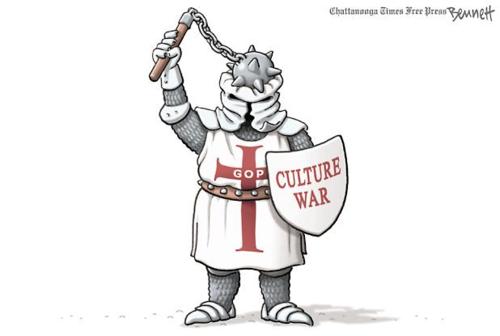
Our Faithless Culture Wars
A while ago, I finally realized that I needed to take Jesus’ teachings much more literally. He said, “don’t judge” and I said, “I’m not judging, but clearly some things are wrong. It’s not judging to say that.” He said, “love, pray for and serve your enemies” and I heard, “love the sinner, hate the sin.” He said, “do not resist the evil man” and I signed petitions against groups and politicians in order to protect Jesus’ values. Jesus said, “so do not worry, saying, ‘What shall we eat?’ or ‘What shall we drink?’ or ‘What shall we wear?'” and I wonder if we should make plans to attend the financial planning series the church is holding on Thursday nights. Jesus said, “the first shall be last and the last shall be first” and I work really hard to be at least in the top quintile in everything I do. See the problem here?
So, haltingly and stumblingly and often failingly, I have tried to unlearn the ways we do things here in the world and adopt the Kingdom way of doing things. What I have learned in the process is that what we see as “standing up for Jesus” or “hate the sin, love the sinner” is really a form of faithlessness. We don’t trust God enough to be able to work things out according to the ways that Jesus told us to do them. We fight and opine and advocate because we are convinced that without our help, God won’t get his way. We think that all that talk about not judging and not resisting and not worrying are good – so far as they go. But there are important issues at play here. If we don’t stand up and fight, we could lose! We could be eating cat food in retirement. “God doesn’t get what it’s like down here” is what I’ve sometimes told myself. Only that’s ridiculous – God made “down here.” He came down here and suffered the worst we could throw at him. And God wins. Always, everywhere. Period. Amen. The reality is that every time I judge or fight or worry or try to keep my position, I’m throwing my lot in with the losing side. Really. Think about that and then think about our culture wars and you can start to see why “the church” has failed so miserably in fighting them. And even more alarmingly, how breathtakingly faithless we are. Continue reading “Our Faithless Culture Wars”


 The Upside Down World