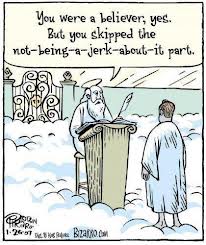
Faith, Doubt and Love

There have been a number of times in the last year or two when I’ve very, very seriously contemplated throwing my faith away entirely. Just deciding that there is no God and chalking all my prior spiritual experiences up to indigestion and an over active imagination. Decide that my fixation on religion was really an unhealthy obsession which had come to cause me more anxiety than comfort. That I should free myself from the idea that there’s something bigger going on with my life so I can make better, more practical and more profitable choices about how to live it. Given the silence of God and the way my life has gone, why not just accept that there is no God and we’re just here by happenstance?

And then there is someone close to me who keeps telling me that he has no doubt that God is real. But he’s also quite certain that God isn’t good. He doesn’t care what happens to us. He’s just as petty and demanding and selfish as the human beings who are supposed to bear the image of God in this world. God made us to be pets, he says. That’s all we are to him – pets created for his own amusement who got out of hand. Now he’s just sick of us. Which isn’t the nicest thought in the world but perhaps it lines up more closely with reality than my high fa-luting ideas about redemption.

I have this thing I do all the time which helps me figure things out. It’s very simple; I just ask myself, “what if this were true?” So any number of times in the last year or two, I have walked right up to these ideas – that there is no God or that he isn’t good and asked, “what if this is true?” In doing so, I’ve learned something important which has kept me from tossing my faith. It’s that even if there is no God or he isn’t good, I still want to live in a world that is being redeemed through love. If it came down to it, I could let almost everything else I believe go, but not that.

Christians often speak about bringing our lives into line with God’s will. And then they parse through scripture or try to read the tea leaves during prayer time to figure out what that will is. But what I’ve learned from walking right up to the line of abandoning the idea of a loving God is that the real question isn’t what God’s will is. What really matters is what my will is. If there is a God or if there isn’t a God, I’m still faced with a choice of how to live my life. What to give my heart to. Whether the world will be better for me having been here or not. And if God isn’t good and doesn’t care what happens to us, too bad. I care. I can’t make God exist or not exist or be good or not be good, but I exist and I can be good.

A lot of Christians believe that there will come a time when Jesus comes back and sets everything right and are just waiting for it. But I decided a while ago that I’m done waiting. I don’t care what God might be waiting for; for my part, I’ve decided that enough’s enough. This world isn’t good enough. Not by a long shot. If God’s not going to come set everything right, then I’ll go right ahead and do what I can to get the ball rolling. If my standards are higher than God’s, then so be it.

Of course, once we get down to it, I don’t actually believe that my standards are higher than God’s. In fact, I believe that this part of me that isn’t willing to settle for the crap we have going on is a reflection of God. Continue reading “Faith, Doubt and Love”

How I Read Scripture

Want to see me turn into a psycho raving wiotch? Say something like this to me: “if the book of Genesis – particularly the creation – isn’t a historical record of what actually happened, then the bible isn’t trust worthy and our faith is meaningless.” Seriously – I made myself stop engaging in online discussions about creation because I am incapable of behaving like a decent human being, much less like a good Christian, when confronted with crap like that. In fact, just recently I broke my rule and ended up telling someone that the “god” he served – who is so weak and pathetic that he can be toppled by some labcoats and DNA – was a worthless piece of filth that wasn’t worthy of being squashed under the feet of the mighty God of the universe that I know. Which while true, may not have been the best demonstration of Christian tolerance and charity that I’ve ever displayed. So now you know why I normally don’t allow myself to partake of such discussions.

But for a lot of people who were taught some version of what is called inerrancy in certain Christian circles, the question does remain – how should we be reading and understanding the bible if not as the factually accurate Word of God, completely free from error or inconsistency? In the last few days, I’ve read a few other people’s explanations for how they deal with the hard parts of scripture or the parts which are in conflict with one another. Mostly the answers seemed to be that if there was a passage which portrayed God in what we’d consider a bad light, they would balance that passage against other passages which contradicted and decide that those took precedence over the negative passage. Or sometimes they would simply view a passage or story as an anachronism – a reflection of the cultural assumptions of the people at the time which was basically put in for their own benefit and not ours. Honestly, the answers I’ve read seem a bit like confirmation of the accusation that people simply pick and choose which parts of scripture to accept as true. So, I thought I’d share my own particular way of dealing with scripture with y’all.

Thankfully, by the time I had been exposed to the idea of inerrancy, I had already read the bible a time or two so I knew enough to take it with a grain of salt. However, I truly hope that it is clear from my writing that I do, in fact, hold the bible in very high regard. It would be hard for me to put into words just how important the bible is to me and the actual love I have for it. Which given the fact that I’m a writer who is seldom at a loss for words is saying a great deal. And I don’t feel free to ignore or dismiss parts of scripture because I don’t like or agree with them. Instead, I actually have a pretty well developed approach for understanding scripture and dealing with the difficult parts which I will try to explain briefly below.

First, I understand that unlike Muslims with the Koran or even Mormons and the Book of Mormon, Christians and Jews have always understood that our scripture was not dictated directly by God. Rather, it has always been considered to be inspired by God and written by men. Which means that it reflects both the input of God and man. A lot of people make the mistake of thinking that the scripture is God’s story alone – that anything which is not completely consistent with the reality and truth of God is absent from it. However, the scripture is rather clearly not just the story of God, but also the story of man. Continue reading “How I Read Scripture”

Is Reading Scriptures Literally, Literally Wrong?*

I came across a blog post by Father Stephen, an Orthodox priest about the problems with taking scriptures literally. On this blog, I have tended to focus on how insisting on taking scriptures literally leaves us vulnerable to being unable or unwilling to deal with reality or to losing our faith altogether when our literal understanding comes into conflict with reality. Father Stephen points out another, probably more important problem with a literal approach to scriptures: it engenders a shallow reading of scripture. From his post:

The Scriptures, particularly those of the Old Testament, are frequently misread (from a classical Christian point of view) in a literal manner, on the simple evidence that the New Testament does not read the Old Testament in such a manner. Rather, as is clearly taught by Christ Himself, the Old Testament is “re-read” from a Christological point-of-view. Thus Jonah-in-the-belly-of-the-whale is read by the Church as Christ in Hades. The first Adam in the Garden is but a shadow and antitype of the Second Adam – the One who truly fulfills existence in the “image and likeness” of God. The Passover and the deliverance from Egypt are read as icons of the true Passover, Christ’s Pascha and the deliverance of all creation from its bondage to death and decay. Such a list could be lengthened until the whole of the Old Testament is retold in meanings that reveal Christ, or rather are revealed by Christ in His coming. . .

A “literal” reading of the Old Testament would never yield such a treasure. Instead, it becomes flattened, and rewoven into an historical rendering of Christ’s story in which creative inventions such as “Dispensationalism” are required in order to make all the pieces fit into a single, literal narrative. Such a rendering has created as well a cardboard target for modern historical-critical studies, which delights itself only in poking holes in absurdities created by such a flattened reading.”

Now, I do know that it is possible to see the deeper Christological meaning of the scripture stories while also maintaining a belief that these things are literally historical events, recorded in scriptures. And certainly there are certain things which we need to be literally true. For example, Paul says in 1 Corinthians 15:17 And if Christ has not been raised, your faith is futile; you are still in your sins.”

However, I think that Father Stephen is right that by seeing much of scripture as a record of events which can be shaped into a literal narrative, there is a strong tendency to “flatten” scriptures into nothing more than an account of historical events. Continue reading “Is Reading Scriptures Literally, Literally Wrong?*”

Sometimes You’re Just All Jacked Up

There’s an episode of the show Family Guy where Stewie, the talking baby, starts drinking so Brian, the family’s talking dog, decides to break him of the bad habit. His plan is to get Stewie so drunk and hungover that he never wants to drink again. So the two head to the local dive bar, The Bearded Oyster. They get soused and at one point as they are about to pound another drink, they are casting about for something to drink to. Stewie says, “Oh – I know, I know . . . to the black man. Thanks for taking it all in stride.”

My husband and I just laughed and laughed at that. Because it’s so true. Our society has basically expected that no matter how poorly treated, oppressed, disenfranchised or unjustly dealt with a black man is, he’s not allowed to be angry or bitter or just plain jacked up in the head. He’s just got to take it all in stride. No stumbling, no falling, no excuses, no empathy, no mercy.

The thing is that this “take it all in stride” ethos isn’t limited to black men. It’s a cultural attitude which affects a lot of us. Whatever happens to us, whatever baggage we got burdened with or barriers we faced or the trauma we’ve experienced, none of that is supposed to matter. You’re just supposed to find a way around or through like a trooper. Get a therapist if you need one, but hurry up and get over it. No use crying over spilled milk. Forgive and move on. Take responsibility for your own life. I’ve heard it and I’ve expected it of myself and you probably have to.

For the most part, it’s not bad advice. I mean you can’t change the past, might as well make the best of it and move forward the best you can, right? The problem is that this generally well meaning advice becomes a sort of moral bludgeoning tool. We stumble and beat ourselves up for it without allowing for the fact that some a-hole had tripped us while another tried to tackle us from behind.

I recently had someone I know say to me, “you’ve chosen such a hard road to walk” and part of me wanted to hunt them down and stab ’em in the eye with a sharp stick. Because the reality is that despite my best efforts, I never did get the chance to walk down the road I had meant to take. Like most people, there were a lot of things that happened that I didn’t create or chose which pushed me down the road I took. And no one stepped forward to help make sure I was OK or that I landed on my feet. Except my husband, but he was even more screwed up than me and did his own fair share of tripping me up. I think I did a good job – a freaking fantastic job, really – of making the best of it. But because I’d deeply absorbed the “take it all in stride, never look back, don’t make excuses” ethos, until pretty recently, I couldn’t allow myself enough mercy to actually say, “I got pushed. I got tripped. My way was blocked and no one would help me out.” It was all my responsibility and I rendered harsh judgment on myself for everything that went wrong or I wished was different. And I allowed others to do the same.

Continue reading “Sometimes You’re Just All Jacked Up”

Love – A Checklist

Everyone likes to think that they are good at loving. After all, we have really strong, loving emotions so surely we must be very loving people, right? But here’s a hint: if the person you love doesn’t experience you as loving, you’re doing it wrong. So in order to help y’all out, here’s a handy-dandy checklist based on the famous 1 Corinthians 13 verses:

Love is patient:

Do you complain that the object of your affection isn’t improving fast enough? Do you get upset that you have to deal with the same problems over and over? Do you wonder why they haven’t gotten their crap together? Or are you willing to allow them the lifetime God has granted them to become who they were created to be?

Love is kind:

Do you assume the best of your loved one? Do you step in to tell them how wonderful they are when they are beating up on themselves – or being beat up on by others? Do you help them write the story of their lives in a way which portrays them in the best light possible?

Love does not envy:

Do you think that your loved one has it easier than you do and resent them for it? When things go well for them do you get upset because things aren’t going well for you? Do you think that they are getting the better part of your relationship?

Love does not boast:

Is it important to you that your loved one recognize your every accomplishment, good dead and sacrifice? Do you feel the need to regularly remind them of what you do for them and how they benefit from being in a relationship with you?

Love is not self-seeking:

Do you have a “what have you done for me lately?” attitude with your loved one? Do you think about the things they could be doing for you, but aren’t?

Love is not easily angered:

Are you quick tempered when your loved one screws up? Are you using your anger to pressure your loved one into keeping you happy? Do you frequently take offense at things your loved one says or does?

Love keeps no record of wrongs:

Do you sometimes throw past errors or intemperate words in the face of your loved one? Do you feel that your loved one is more often in the wrong than you? Do feel that some past sin or error has created an imbalance between you which they need to make up for?

Love does not delight in evil:

Continue reading “Love – A Checklist”

Why We Christians Suck at Loving

Is there something about Christianity itself which leads to the sort of oppression which its adherents have too often been guilty of? You know – the inquisitions, colonialism, slavery, pretty much every interaction we ever had with First Nations people in the Americas. To name a few. The standard answer for western theologians is that the Christian faith and its teachings are not the problem – people’s sinful natures are. It’s the, “well those aren’t real Christians” blow off. However, South Korean theologian Andrew Sung Park posits a more honest – and more helpful – answer to this thorny issue of the convergence of Christianity and oppression. The problem as Sung Park sees it is that we westerners see Christianity as the answer to the problem of the sinner. All have sinned and fallen short of the glory of God, so Jesus came and died for our sins so we can be forgiven and all that. Our theology, Sung Park argues, elevates the needs and concerns of the sinner over the needs and concerns of the people sinned against. And therein lies the problem.
This may seem akin to blasphemy for many Christians for whom the problem of sin and sinners is THE message of Christianity. However, compare our sinner-centered approach to Christianity to the words which Jesus actually spoke.When Jesus started his ministry, this was the text he chose:

“The Spirit of the Lord is on me,because he has anointed me to preach good news to the poor.He has sent me to proclaim freedom for the prisoners and recovery of sight for the blind,to release the oppressed,to proclaim the year of the Lord’s favor.” ~ Luke 4:18-19

Jesus’ most famous sermon – the one which many scholars believe was his “stump speech” – the oratory he gave when he traveled to a new place and crowds gathered to hear him centered on this:

Continue reading “Why We Christians Suck at Loving”

Join Me for Lent

When I was 14 I gave up swearing for Lent. And I actually broke the habit entirely for a few months. But that summer I got a job working in a hot, humid greenhouse with a bunch of crabby old ladies who smoked and swore all day long. I’m glad to report that the smoking didn’t rub off on me. I tried giving up swearing again for Lent the next year, but after a few days I decided that it didn’t really count as giving something up if you just kept doing it anyways. So I switched to chocolate. Which is just as well. I happen to love swearing and consider it a valuable life skill. (Recently I left a comment on a blog explaining why I have no problem being a swearing Christian and the first person who responded told me that I should take a logic class before deigning to speak again. He signed his name with his degrees behind it. It was quite amusing all around.)

So anyways, I no longer give things up for Lent, but I do often try to pick up a specific Christian discipline for the season. Now, I know that some of you come from church backgrounds where Christian discipline involves spiritual abuse and lots of meetings with the pastor. Rest assured, that’s not the sort of Christian discipline I’m talking about. Rather, Christian disciplines are simply specific practices which one engages in with the intent of deepening your faith life. It could be fasting, praying the Jesus prayer, engaging a spiritual director, using the book of common prayer, meditation or walking a prayer labyrinth to name just a few examples.

This year I’m going to be doing morning and evening offices through the season of lent – and I’d like to invite you to join me. For those of you who aren’t familiar, Daily offices or Divine hours as they are also known come out of monastic communities which structure their day around prayer services which take place at set hours each day. The practice is said to date back to the Apostles and comes out of the Jewish practice of saying prayers at set times. (For example, in the Book of Acts, Peter and John visit the temple for afternoon prayers. – Acts 3:1) Aside from monastic communities, the practice of “keeping the hours” as it’s sometimes called, is often associated with high church Episcopalians. But any Christian can use/do them. In case you were wondering.

Basically an office is a prayer service which includes prayers, readings from the psalms, scripture, maybe a meditation and a hymn. Some communities use the same prayers each day while changing the scripture readings each day. Others use different prayers or cycle through a set of prayers over the course of a week or month. If this all sounds confusing – it’s not. Unless you’re the poor soul charged with actually putting these services together. For those of us who are simply showing up to join in, it’s very easy. So easy, in fact, that you don’t even have to leave your house. Hell, you don’t even have to get off the computer! There are a variety of places which put up the day’s readings and prayers online. You can just read along at your own pace in your own time. Some even include audio files if you would like to listen or recite them out loud along with a prayer leader.

Of course, this may all sound a wee bit high churchy for some folks. And perhaps you’re wondering why you ought to do such a thing. Well, let me give you three reasons:

Continue reading “Join Me for Lent”

Psalm 73 ~ A Meditation for the Weary, Bitter, Stumbling Soul

These were the words I needed this week:

Psalm 73

Surely God is good to Israel,
To those who are pure in heart!

But as for me, my feet came close to stumbling,
My steps had almost slipped.

For I was envious of the arrogant
As I saw the prosperity of the wicked.

For there are no pains in their death,
And their body is fat.

They are not in trouble as other men,
Nor are they plagued like mankind. . .

They mock and wickedly speak of oppression;
They speak from on high.

They have set their mouth against the heavens,
And their tongue parades through the earth.

Therefore his people return to this place,
And waters of abundance are drunk by them.

They say, “How does God know?
And is there knowledge with the Most High?”

Behold, these are the wicked;
And always at ease, they have increased in wealth.

Surely in vain I have kept my heart pure
And washed my hands in innocence;

For I have been stricken all day long
And chastened every morning.

I haven’t made a secret of the fact that I’ve been on a wretched and miserable path for a long time now. But what I’ve been a bit more reticent in sharing is that seemingly at every turn, there have been people just waiting to condemn me for my wretchedness. Those who did evil to me would criticize me for walking down paths they had helped to push me onto. Those who turned me out when I was weak would point to my homelessness to condemn me. Those who cut refused to have me around would express shock at the company I was able to keep. Those whose actions crippled me complained bitterly that I was lame and slow no matter how good my work was or how remarkable my healing had been. When I would point to God as the northern star I was following, the response was just like in this psalm: “what does God know? Is he going to pay your bills or fix your car or mend your relationships? Forget God – look at the mess you’re in!” Continue reading “Psalm 73 ~ A Meditation for the Weary, Bitter, Stumbling Soul”

Stuff I Appreciate About Black Folks

Hey – want to watch me stick a fork in an electric outlet? ‘Cuz that’s pretty much the same thing as being a white person who talks about black folks, right? Or at least some would have you think so. But I’m going to do it, because African Americans are forever getting dumped on in our society and are rarely called out for all the things that are great about them.

Now, before I get started, allow me to provide proper cover for myself. For those not in the know, I’m married to a black man. I have 5 mixed race kids and two African American stepsons. So if nothing else, my “I have black friends” creds are actually solid. (I’ve written more about my experience with race here and you can learn more about my $.99 ebook on race in American here.) Of course, there is as much variety among black folks as among any other group of people. I’ve known sweet, shy, reserved black women and loud, sassy, confrontational black women. Macho black men and nerdy black men. And the things I’m going to list here aren’t universal. There are always people who go against the grain. But as a general rule, these are things which I have observed to be common among black folk I have known that are not nearly as prevalent among the white folks I have known.

Of course, every positive trait has a dark side when pushed to far. My goal isn’t to idealize African Americans, but like I said, we continually dump on black folks and discuss problems in the black community. For this post, I’m just focusing on things which I personally appreciate about black folks I have known. So having properly covered my ass, here goes:

1. They respond to your problems with grace and understanding.

Probably because black folks have had to deal with so many really serious, awful problems for so long, they aren’t particularly phased by your problems. Usually they’ve heard or seen it all before – and worse. And if your life is going to hell because you did something wrong, well, the black folks I’ve known probably disapprove of your dumb choices as much as anyone else. But they also know that you’re the one who is going to have to live with the consequences of your dumb choices, so there’s really no point in piling on. Better to help you move forward than waste time berating you much less exacerbate the problem by turning you out. In my experience, if your life goes all to shit, you’re much better off going to your black friends or a black church for support than to your average middle class white person or church. Continue reading “Stuff I Appreciate About Black Folks”

John the Baptist Says to Stop Being an Arse

Some of you will recall that I was raised Catholic. So each week at mass I would listen to a reading from the Old Testament, the New Testament and the Gospels. And at the end of each the person reading would intone, “The Word of the Lord” and we’d respond together in monotone: “Thanks be to God.” Because we were so excited.

Now, I understand the intent of this little ritual and I truly do offer thanks to God for his Word. But now that I’ve actually read the bible myself, I kind of think that all of heaven must occasionally roll their eyes and guffaw at this response to scripture. Like say that day’s Old Testament reading was from 1 Samuel 6 where the Philistines have stolen the Ark of the Covenant from their neighbors and been duly smited. To set things right, they are instructed to “make models of their tumors” as well as of rats out of gold to give to the Israelites when they return the object. Can you imagine? Make models of your tumors? You cannot tell me that the Israelites didn’t laugh their asses off at being given a bunch of gold lumps cast from the Philistine king’s goiters. And we respond with the same old monotone “Thanks be to God” in such a way that makes it clear that we’ve missed the joke entirely. Once again, these stories and poems and words, so filled with beauty and passion and humor just get flattened into monotony and so lose their power. It’s kind of sad the way we do that (and no – this is hardly a Catholic problem!).

I was thinking about this last night while reading a story about John the Baptist which really, could have come right out of a Monty Python skit:

And the crowds were questioning [John the Baptist], saying, “Then what shall we do?” And he would answer and say to them, “The man who has two tunics is to share with him who has none; and he who has food is to do likewise.” And some tax collectors also came to be baptized, and they said to him, “Teacher, what shall we do?” And he said to them, “Collect no more than what you have been ordered to.” Some soldiers were questioning him, saying, “And what about us, what shall we do?” And he said to them, “Do not take money from anyone by force, or accuse anyone falsely, and be content with your wages.”

Can’t you just see it – here’s this wild-eyed crazy man out by the river and people come to ask him what they should do to be saved from the coming wrath. He leans in, maybe puts a stinky arm around the questioner and essentially says, “listen closely – stop. being. an. ASSHOLE.” Like it’s some big friggin’ secret or something. Continue reading “John the Baptist Says to Stop Being an Arse”