





How being gifted means being different
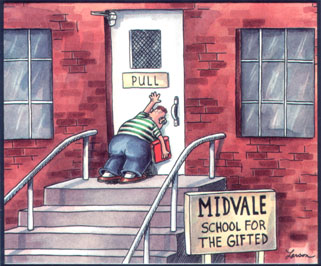 Over the last couple of years I have spent time off and on doing research into giftedness and living with unusually high intelligence. It has been far more interesting and enlightening than I expected. So I figured I would share some of what I have learned with y’all. Today I will focus on some of the differences which tend to be characteristic of those with unusually high intelligence. Tomorrow, I’ll get into why so many gifted people have a hard time recognizing themselves as gifted and why it is so important for them to understand their giftedness and teach their children to do the same.
First, the differences. I always figured that high intelligence was just about how a person learns new information and skills. What I have found out, however, is that high intelligence entails not just being able to learn new things quickly and easily, but affects a person’s entire experience of life. People with unusually high intelligence take in and acquire information differently, process that information differently. They frequently experience emotions and physical stimuli more intensely than others. They have motivations and drives which others often find odd or bizarre. In short, being unusually intelligent tends to create a whole life experience which is markedly more complicated and intense than what most people experience.
Psychologists who deal with highly intelligent people label these areas of high instensity and complexity “Overexcitabilities” or OEs. Continue reading “How being gifted means being different”

Summer Camp and Peer Socialization
My 9 year old spent last week at a nearby nature center for summer camp. It ran from 8-4 with an overnight camp-out Thursday night. It was really the first time he’s spent that much time in that short a period away from his family. He had an absolute blast, got along very well with the other kids and only had one serious discipline problem … Continue reading Summer Camp and Peer Socialization
I am amazed
God works. That’s all I can say. You may have heard the howling and gnashing of teeth on both sides over University of Minnesota at Morris professor P.Z. Meyer’s quest to desecrate a eucharist. He finally got his hands on one (I didn’t read closely enough to see if it was a consecrated host or not, which to Catholics would be enormously important of course). … Continue reading I am amazed
The power of culture or the power of economics?
 Alright, alright, enough of the hiatus! Let’s get back to this here thing.
I recently ran across a story which mentioned a variety of studies that have found that imposing financial fines for poor behavior can actually increase that behavior. For example, studies at day care centers have found that when schools impose fines for parents who pick their children up late, they actually see an increase in the frequency of late pick-ups. It turns out that parents were more lax about picking their children up on time when they saw their obligation as financial rather than social. The social obligation to respect the time of the child care workers who would be inconvenienced by a tardy pick-up was a far more powerful motivator to good behavior than economic consequences.
Social scientists have observed this dynamic at work in a variety of settings and places around the world. Yet, over the last few years we have been trained to assume that economic issues are at the root of everything from social problems to the behavior of corporations to foreign policy affairs. Which to a certain extent makes sense. After all, economic concerns obviously have real effects on people’s behaviors and choices. For example, there was a sharp drop in the birth rate during the great depression as having a large family became more difficult economically. And we have all benefited from the increased prosperity which has resulted from our free market system where the only objective is to increase economic gain (without breaking the law, hopefully).
However, the simple truth is that humans have been social creatures much longer than we have been economic creatures. It really is difficult to overstate the power that social norms and expectations can have on people. Continue reading “The power of culture or the power of economics?”
Is the bible an instruction book?
We’ve probably all seen a pastor stand up with a bible and declare, “this is God’s instruction manual for life.” Or seen those bumper stickers which say, “God said it, I believe it, that settles it.” The idea is that we can just flip open the bible and find instructions, directions and formulas for living our lives. Which if your only encounter with scripture comes … Continue reading Is the bible an instruction book?
May Wonders Never Cease
Last night my oldest son Noah announced to his little brother, “you can use the computer all day tomorrow. I’m going to be busy working on writing my story.” As of right now, I think he has 5 pages written in his notebook. This is my child who HATES writing more than just about anything. If I get him to put a pen to paper, … Continue reading May Wonders Never Cease
Liberal-Conservative Quote of the Day
“Conservative, n: A statesman who is enamored of existing evils, as distinguished from the Liberal who wishes to replace them with others.” – Ambrose Bierce, satirist. Continue reading Liberal-Conservative Quote of the Day
My potty training baby
You know how your grandma told you that all of her children were potty trained by 13 months? And you know how although you don’t believe her for a minute, somewhere in the back of your head you hope that it’s actually true? Because it gives you some delusional hope that maybe your baby will be out of diapers before they can talk. Well, it’s … Continue reading My potty training baby
What Liberals Don’t Get
Tonight I was listening to This American Life on NPR. The story I was listening to was about 2 middle class guys who became homeless in New York City and lived in the streets for a couple of years while becoming writers. While being asked about what it was like to be homeless, the men noted that there is no such thing as a hungry … Continue reading What Liberals Don’t Get
A Gathering of All Believers?
 Last night I wrote about my theory that the church is not effective in large part because of its divisions, that this ineffectiveness and division leave many people wandering and doing what seems best to them and that in order to counter this the church needs to reconsider its basic conception of itself. Today, I want to discuss a bit further what would/will need to happen for us to overcome our divisions and create more effective churches.
A month or so ago, I was involved in a discussion in the comment boxes over at Jesus Creed where regular commenter (and sometimes fill-in blogger) RJS said this:
I am an evangelical Christian and a scholar – but – I would not teach at an evangelical Christian institution with a restrictive statement of faith beyond essentials, even a statement of faith with which I currently agree. I am also ambivalent about church membership in any restrictive denominational church, despite the fact that I think we must affiliate in local congregations. We are called to be part of the body of Christ – the Church.
Attaching much importance to nonessentials sets a bar for Christian fellowship beyond Christian faith. I think that this has at least three, and probably more, truly negative impacts.
(1) It divides Christians, despite the fact that we are called to unity.
(2) It leads many to an unhealthy ironic faith (borrowing Scot’s term) where one may not really believe that to which one gives nominal assent.
(3) It prevents many of us from ever feeling truly secure in Christian fellowship.”
I have thought about this quite a bit since reading it a couple of weeks ago. Can we Christians simply decide that anyone who is willing to affirm the early church creeds (Apostle’s/Nicene Creed) belongs in full fellowship with us? Continue reading “A Gathering of All Believers?”
 The Upside Down World