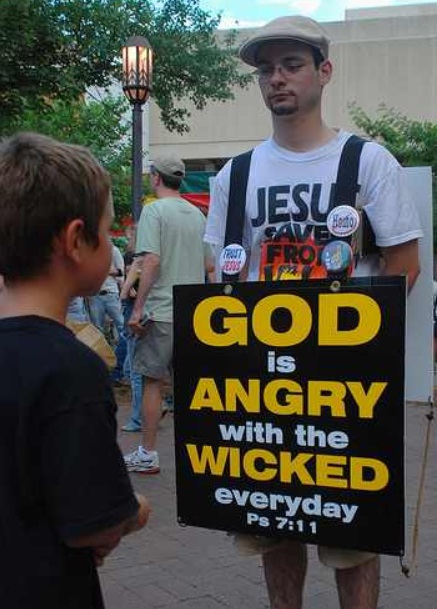
There’s a long tradition in Christian circles of painting vivid images of hell in order to scare people into acting right, believing the right things and buying books. In fact, some people claim that the popularity of early colonial pastors who gave particularly vivid or gruesome hell and brimstone sermons was due to attendees coming seeking a good scare and some entertainment. The colonial version of horror movies, they say. Believe it or not, to this day those people who stand on street corners telling everyone that they are going to hell occasionally get someone to believe them and pledge their lives to Christ. In fact, so great is the human desire to avoid hell, I’m going to use it as my own excuse for procrastinating this blog post all day long. After all, today is the day that we actually talk about hell.
So, what the hell is hell anyhow? Aside from having your mother in law come to visit, that is. Well, there are 4 words that have been translated as “hell” in the bible. The Hebrew sheol and the Greek hades, Gehenna and tartarus. Going back to the Septuagint (the Greek translation of Hebrew scriptures used between 200 BC and 300 AD), we see that sheol is always translated as “hades”, so for our purposes we will consider these two words to be synonyms. Both sheol and hades are simply the place of the dead. In Greek mythology, everyone – good and bad – went to hades when they died. Mostly it was thought that the breath of a person continued to exist in hades but had no consciousness.
Sheol
This idea that in the grave there was no conciousness is also reflected in verses using sheol such as Psalm 6:5 – “For the dead do not remember you. Who can praise you from the grave (sheol)?” and Isaiah 38:18 – “For the grave (sheol) cannot praise you, death cannot sing your praise; those who go down to the pit cannot hope for your faithfulness.”
Psalm 89:48 speaks of sheol as the destination of all men rather than the domain of the wicked: “Who can live and not see death, or who can escape the power of the grave (sheol)?” In Genesis 37:35 Jacob refuses to be comforted over the loss of his son Joseph saying, “I will continue to mourn until I join my son in the grave (sheol). ” Repeatedly in the Psalms, the psalmist credits God with saving him from the depths of Sheol (ex Ps 18:5, 30:3). In fact, in Psalm 139, the psalmist says that God himself is in sheol: “Where can I go from Your Spirit? Or where can I flee from Your presence? If I ascend to heaven, You are there; If I make my bed in Sheol, behold, You are there.”
Modern translations translate sheol either directly – using the word Sheol – or use the word grave. The King James Version translated sheol as hell when it was spoken of in reference to the wicked and as grave in other places. Here’s a list of all the bible verses containing sheol. Since most modern translations do not translate the word sheol as hell, the word and notion of hell have pretty much disappeared from the Old Testament. Continue reading “What the Hell?”





 The Upside Down World