Ways to Make a Christian Faint

“Christians have always tended to transform the Christian Revelation into a Christian religion. Christianity is said to be a religion like any other or, conversely, some Christians try to show that it is a better religion than the others. People attempt to take possession of God. Theology claims to explain everything, including the being of God. People tend to transform Christianity into a religion because the Christian faith obviously places people in an extremely uncomfortable position that of freedom guided only by love and all in the context of God’s radical demand that we be holy.” –Jacques Ellul

We Christians really are a faithless bunch. Want to send the average Christian – particularly a Christian like a pastor or church elder – into a nervous sweat? Tell them, “Jesus said the world would know his disciples by how loving they are” without adding any qualifiers at the end. No mention of morality or the need for correction. In fact, if you want to send them into a dead faint, point out that the biblical definition of love doesn’t include correction, purity or virtue.

Or tell them that you’ve decided to take Jesus’ instruction not to judge literally. From here on out you’re just going to take a live and let live approach. A person’s choices are between them and God so you’ll just leave the judging to God. You may want to bring smelling salts. If they’re still standing, you can add in that Jesus said we should be perfect like God who causes the rain to fall and the sun to shine on the good and evil alike. So you think we should help anyone in need without regard to whether they deserve it or not. And no making loans – if you’re going to help someone, you need to do it without expecting repayment. That should finish the job.

You could suggest that instead of fighting to protect our rights, Christians should follow Jesus’ teachings and example and refuse to fight. Let the other side defeat us without resisting it. They’ll either give you a blank, uncomprehending stare or quickly escort you off the premises.  On the way out you could add in that God doesn’t really care if you receive or keep what you’ve earned through hard work. Just to make sure you’re never invited back.

Of course, not all Christians are like this. There’s a growing segment of Christians who already have a live and let live attitude. They work hard to be loving, accepting and willing to lose. Not that they have it all together either. Try telling them that no one has a right to inflict the horror of fatherlessness on another human being, so Christians are morally obligated to refrain from sex outside of marriage and to encourage others to do the same. Tell them its a matter of social justice. Be prepared to witness much equivocating. Continue reading “Ways to Make a Christian Faint”

When My Beloveds Talk Together

I’m going to tell you strange things today. Like about the times early in my marriage when I prayed to God, telling him about the pain of being married to another broken human being. I brought to God things I had never said to my husband because I knew he wouldn’t be able to receive them. And it happened more that once that my husband came home from working so hard to take care of us and said, “today, I really felt like God was telling me . . . ” And nearly word-for-word what I had said to God came out of his mouth. It turns out that the man who God provided for me has an uncanny ability to listen and hear God. It wasn’t the last time he would tell me things he had no way of knowing.

But one of the strange things about this life is that as much as we might want and seek after God as a way of protecting ourselves from the chaos and pain of life, it just doesn’t work that way. In time when the blows of life finally overtook us, this marriage of ours fell apart. I’d always said that we’d either end up as one of the world’s great love stories or self-destruct in a truly spectacular fashion. For a long time, it has seemed that the latter was our fate. It wasn’t that we stopped trying – far from it. In fact, in the middle of our worst arguments, my husband began to stop to pray and listen to God. I followed his lead and began doing it as well.  We became the only couple in all of creation perhaps that would actually stop to seek God in between throwing accusations and curses and venom at each other. And yet, even with both of us seeking after God, our marriage continued to devolve.

Only I’ve discovered that hearing God isn’t enough. In communication there is what is said, what is heard and what it understood. And it turns out that one must know God better than we humans actually know him to understand what he is saying. I learned this when one day my husband told me, “be careful – God told me that there are two voices you are hearing.” The way he said it made it clear that he thought I was being deceived. This was his own belief – that I was wrong and refusing to deal with reality. He thought God was confirming this. Only unbeknownst to him, I had been praying regularly to God complaining that I was no longer sure if I was listening to Him or just hearing what I wanted to hear – talking to myself. Over and over again, I had asked, “how do I know that when I think I hear you, I’m not just hearing what I want to hear?” And he answered me – “you’re hearing two voices.” I knew what it meant – you’re not just talking to yourself. But my husband, working with a different set of assumptions and knowledge, took away something totally different. As we can see perfectly well with all the people who know God’s word yet know little of love, simply hearing God is quite different from understanding Him. Continue reading “When My Beloveds Talk Together”

Godly Thinking vs The World

“Encourage one another and build each other up ~ 1 Thessalonians 5:11 Godly thinking believes you can be the person you heart desires to be and accomplish the things your heart longs to accomplish. The world believes you can be the person they want you to be and accomplish the things they think you should want to accomplish. “Do not be conformed to this world, but … Continue reading Godly Thinking vs The World

Why I don’t consider abortion when voting

Let me be clear up-front: I do not support a right to abortion on demand. In fact, if I were made ruler of the universe, I would make abortions enormously difficult to get. Because I’m a mean and cruel woman. No, not really – I’m actually very kind and empathetic. But I am in agreement with Mother Theresa: “it is a poverty to decide that a child must die so that you may live”. I don’t think abortion is an answer to what is really a societal failure. I don’t only oppose abortion from a pro-life perspective. I think abortion is bad for women, worse for relations between men and women and displays a level of animosity towards women as they are – people whose bodies can start new life – which is evil and vile. If we have a society where the normal functioning of a woman’s body regularly ruins women’s lives, we’re doing it wrong. And abortion doesn’t do anything to fix that – it simply enables it. Nearly 60% of abortions are influenced by pressure from fathers, husbands, boyfriends or others with power in a woman’s life. That’s not empowering. Nor has ready access to abortion resulted in a world where people who shouldn’t have children don’t as abortion proponents used to argue. Far from it. And yet . . . the issue of abortion has nothing to do with how I vote.

Yes Democrats not only support abortion rights, but celebrate them the way most of us celebrate Grandpa’s 90th birthday. But despite using the abortion issue to garner votes for the last 30 or 40 years, Republicans haven’t and won’t do anything to stop abortion either. Sure, they’ll fiddle around the edges and I’d much rather live in a country where doctors don’t deliver a baby up to its neck before suctioning its brains, crushing its head and completing delivery. But show me one child who is alive today because we banned “intact dilation and extraction”. It’s a symbolic victory at best. The reality is that for all their rhetoric, the Republicans have shown no more willingness to do something about Roe v Wade than their Democratic opponents. If anything, I can at least give the Democrats credit for being honest about their support of abortion as birth control. But voting for someone simply because they claim to be pro-life does nothing what-so-ever to advance pro-life policies. It’s just giving my vote to the person who has set their dog-whistle to the right pitch.

Another reason abortion isn’t a factor in my voting is that abortion is only marginally a legal issue. 1.2 million women have abortions each year. By some estimates, one in three women will have an abortion in her lifetime. Including a good number of women who are Christian, pro-lifers. That’s a social problem. You don’t fix social problems with laws. Social problems get fixed with people. Continue reading “Why I don’t consider abortion when voting”

The Sacrifice of Isaac . . . Or Provincial Much?

Shall I offer my firstborn for my transgression, the fruit of my body for the sin of my soul? He has showed you, O man, what is good. And what does the LORD require of you? To act justly and to love mercy and to walk humbly with your God. ~ Micah 6:7-8

In the pantheon of weird stories in the bible, the Sacrifice (or Binding) of Abraham is often treated as the most inexplicable or as the clearest evidence of how capricious the God of the Old Testament is. However, it seems to me that these conclusions simply demonstrate our poor understanding of history, God’s ways and human nature.  In context and with a decent concept of human nature as well as a proper understanding of what God is about, the story and it’s moral aren’t so hard to understand.

The reality is that infanticide has always been part of human behavior. It’s been practiced everywhere and through all time periods. Including during the time of Abraham. In fact, there is evidence from both ancient writings and from archaeology of wide-spread infanticide and ritual child sacrifice in the Ancient Near East continuing into Greco-Roman times. Continue reading “The Sacrifice of Isaac . . . Or Provincial Much?”

Do you read scripture like a Pharisee or like Jesus?

Way back in college, I took a class on the history of religion in America. One day during a discussion about some Christian evangelist, one of the other students offered this criticism of the man’s work: “it’s like he’s actually trying to be like Jesus.” I sat there a bit bug-eyed. Can you imagine – a Christian who was actually trying to be like Jesus? Whatever could that evangelist have been thinking? (Clearly, not everyone I who attended my college was the best or the brightest.) But the reality is that a lot of people – including a good number of Christians – are as unclear on the concept as this young man back in my college days was. How else to explain the fact that many people read the bible the exact same way that the Pharisees did rather than trying to read it like Jesus did? (For anyone who is really unclear on the concept – the Pharisees were Jesus’ main opponents in the gospel stories. We’re supposed to try to be like Jesus, not like the Pharisees. Just so we’re all on the same page here.)

At the time of Jesus, the Pharisees were experts on the bible. In fact, they had managed to find all the laws in the bible – 613 of them. They had further figured out that there were 365 negative laws – thou shall nots. And 248 positive laws – thou shalls. So they knew all about important rules like thou shalt wash your hands before eating, thou shalt not perform miracle healings on the Sabbath and how long to keep the fringe on their garments. Somehow they had managed to miss those very important rules about card playing, drinking alcohol and dancing. No one’s perfect, I guess. But they had mastered the very important biblical teaching to avoid the appearance of evil. Like they wouldn’t eat with unclean people because if they did, the other biblical rule followers might call them evil. And evil is bad, donchano? (I once attended a church which demanded that members not drink alcohol on the grounds that other church members might be scandalized if they saw you coming out of a liquor store.)

So long before the teaching of sola scripture, the Pharisees were experts in biblical living. If you needed to know the biblical way to weave your cloth was, they could tell you. (Using only one type of fiber is biblical. The Pharisees would not have stood for our unbiblical polyester/cotton blends!) The Pharisees were also very good about setting a good example for other people – praying in public or announcing their contributions to the synagogue loudly. Because it was important to “witness” to those around them so that people would be inspired to honor God the right way, of course. Continue reading “Do you read scripture like a Pharisee or like Jesus?”

“Masculine Christianity” and Men

My husband has often remarked to me that the heart of the problems we have in understanding God is one of translation. No matter how we try, the words we use to express spiritual truths can’t fully capture the reality they describe. Especially for “people of the book” such as we are, words are the medium through which we explain God to ourselves and each other. But as powerful as words are, it is exceedingly difficult to translate the spiritual into the spoken (or read) without flattening what is being described – sometimes to the point of obliteration. It’s a bit like explaining sex to a 9 year old – you can explain how it works, but they will walk away with no concept of why anyone would want to do such a thing. Descriptions don’t always illuminate reality.

When it comes to our Christian/Hebrew attempt at translation, scripture relies heavily on that good writing maxim: “show, don’t tell”. So we have a book filled with stories, poetry, a couple of books of rules, genealogies and some letters of exhortation. Its more like giving a 9 year old a Danielle Steel novel in lieu of explaining the mechanisms of sexual intercourse. They may come away a bit fuzzy on the details, but with a better grasp of what it is they have to look forward to.  Better, but still not complete.

One of the oddities of Hebrew and Christian texts is the extent to which they avoid describing the spiritual at all. There is no attempt to really discuss the nature or substance of God. Very little is said of where we come from or where we are going to outside of this physical realm. Questions such as the relationship between the physical world and spiritual world are vague at best. While our stories and poetry help to flesh out the relationship between God and mankind, the reality of the spiritual is something we must seek to experience for ourselves. Christianity has always hinged on experience rather than belief. Few people come to a life-altering Christian faith because they got to know the bible and theology and decided to follow it. At some point, most people must have a spiritual experience of love or connection to bring the whole thing to life. Even the most lurid erotica is a poor substitute for the real thing, after all.

So, what does all of this have to do with “Masculine Christianity” and men? Continue reading ““Masculine Christianity” and Men”

“What is truth?”

So, are you sick of the arguments yet? You know the arguments – Romney vs Obama. “Job Creators” vs Inequality. Creationism vs Evolution. Pro-Choice vs Pro-Life. Old Fashioned vs New Fangled. Text Speak vs Grammar Nazi’s. Toilet Seat Up vs Toilet Seat Down. Whatever it is, if we can figure out two ways of looking at an issue to divide ourselves into, we do it. And then we argue and argue and argue. We refine our arguments and wonder what the hell is wrong with the people who don’t agree with us. But aren’t you sick of it?

I remember years ago an older, wiser friend told me, “arguments don’t work. You never change someone’s mind through arguments.” At the time I was a bit flabbergasted. If we didn’t argue, how would the other person know they were wrong? And if we can’t get everyone pretty much on board, how do we keep the world from going to hell in a hand basket? I mean, what was the alternative?

Of course, today we have reams of research and endless gigabytes of internet conversations to prove that what my friend told me was true: arguments don’t work. They rarely change anyone’s mind. And I think all but the most die-hard believers are starting to get sick of them.

So what is the alternative to argument? Do we just agree to disagree – you have your opinions and I’ll have mine? And what about truth? Aren’t some things just true and shouldn’t we stand up for and advocate for them? If we can’t argue and persuade our way into some consensus about what’s true how can we function together to get anything done? The live and let live concept sounds fine until we need policies to get the economy going or fix serious social problems. Then what? Continue reading ““What is truth?””

Tebowing ™ – Harmless, Faithful or Whore of Babylon Stuff?

So, just this morning, I was explaining to my husband that I feel pretty strongly that my blog is not the place for me to engage in criticism or debate. Rarely, if ever, will you hear me weighing in directly on the latest debate or controversy. And I engage in direct criticism of others next to never. I’d rather make a positive case for what I think and allow it to stand or fall on its own rather than use other view points as a foil. Yup. That’s what I was saying just this morning. Now watch as I throw all that out the window for a moment in order to discuss a news story that embodies a serious error in the way many of us practice our Christian faith.

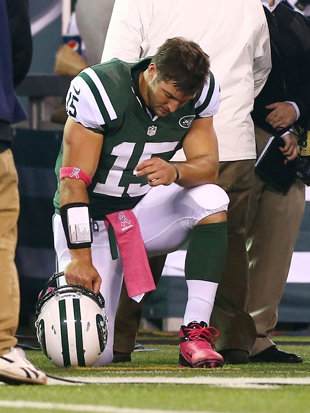
So, in case the title of this post didn’t clue you in, the news story I’m referring to is that American football player Tim Tebow has filed a trademark on the word “Tebowing”. ‘ (For those of you who don’t keep up with such things, Mr. Tebow is an outspoken Evangelical Christian football player. He is known for dropping to one knee on the field after successful plays/touchdowns for a quick “prayer”. The gesture has been called “Tebowing”. He’s seeking a trademark on the word, not the gesture.)

Now, I should stop right here and make a few things clear. First is that I have no idea what the quality of Mr. Tebow’s faith life is. I cannot possibly say whether he has a genuine faith, an actual relationship with God or what his heart is. By all accounts he is a good man. Secondly, I am picking on Mr. Tebow here, but his actions don’t exist in a vaccumn. Rather, they are an entirely consistent playing out of the values, beliefs and practices of a large segment of the American church. His actions just provide an unusually high profile case study. So, that being said, allow me to explain my issue here. Continue reading “Tebowing ™ – Harmless, Faithful or Whore of Babylon Stuff?”

Does God Get Angry?


If you haven’t contemplated murder, you ain’t been in love. ~ Chris Rock

“I will turn my beloved people over to the power of their enemies. The people I call my own have turned on me like a lion in the forest. They have roared defiantly at me. So I will treat them as though I hate them. The people I call my own attack me like birds of prey or like hyenas.” ~ God (Jeremiah 12:7-9)

Over the weekend I happened to come across an email I had sent my husband a couple of months after he left me and the kids. (Background here and here.) It was just a short note rejecting his request that we strive to be on friendly terms. Not that I wanted to be in conflict, but I wasn’t going to pretend to be OK with someone who had treated me the way that he had. In fact, I think it would have been really unhealthy for me to agree to be friend-like under the circumstances. I was very, very angry and I had a right to my anger. I had been betrayed, rejected and turned on by someone who I had done my best to love unconditionally through thick and thin. Emotionally, I was not in any condition to have anything more than a cold, barely cordial relationship with him. (As always, I am speaking of my own perspective here. My husband could give you an encyclopedic list of all the ways he feels I wronged him as well.)

During those days in between praying fervently for God to hit my husband with a bus, I was often grateful for the words of 1 Corinthians 13:5: “Love is . . . not easily angered.” It meant that there was room in love for anger. The two aren’t mutually exclusive. I hadn’t turned into a terrible, hateful, unloving person because of my anger. I didn’t have to be afraid of it or deny it or hurry up and get rid of it. In fact, being so angry was a legitimate part of being a loving person. I knew I would be able to work through it in time. Continue reading “Does God Get Angry?”