Defiance is a Christian Virtue

The moments in my life that have been most sure and which have left me with the most peace and joy have been moments of defiance.  The times when, even though no one else would get it, I knew the path I needed to take forward and I took it.  These are my reckless moments.  Those things that caused offense, consternation, even concern for my sanity among those watching.

I am often a very cautious person.  I don’t go shopping without knowing what I’m going to buy and how much I’ll pay for it.  I skip the “trust” part of “trust, but verify” and go straight to verify.  I can explain the things I do and the choices I make down to a level of detail that could put a hyper-active 7 year old to sleep.  I think of what I’m going to say before dialing the phone.  I think of questions I can ask people and topics to discuss before I get into conversations.  I bite my tongue often.  I handle my relationships with kid gloves lest I damage them or hurt someone unintentionally.

So these moments of defiance must seem out of character to anyone who doesn’t understand what’s going on beneath the surface.  But these moments of defiance are my most true moments.  They are the moments when what is beneath rushes to the surface and propels me forwards, regardless of all the consequences.  Because I already know all the consequences.  And not one of them – not disapproval, the loss of relationships, poverty, pain or anything else – is nearly enough to stop me from doing what I know I need to do.  I can be reckless because I know that I’m doing something I have been specifically called by God to do or because I know that the damage done to myself if I do not do them is far greater than any of those consequences could be.  I can be defiant because I have examined the matter through and through and I know that it’s coming from a pure place in my spirit.  You have to be willing to be defiant if you are going to follow God and allow him to restore your heart. Continue reading “Defiance is a Christian Virtue”

“You’re so sensitive!”

“You’re being too sensitive.”

Oh are those ever familiar words.  All through my childhood they trailed after me like a tin can tied to the end of my shoelaces, with each step in danger of sending it bouncing across the floor.  The sound of those words clanging along behind me made me wince until I could hardly bear to move from my spot any more.  One day, when the strain of being planted in one spot got to be too much for me, I got wise, cut the string and walked away.  For a long time though, the memory of that ugly sound haunted my steps.   But many, many years of freedom from the constant accusation “you’re too sensitive” faded even that away until I was able to move about my world with an ease I had not dreamed was possible back when I was trying to be quiet and still enough not to send that tin can clattering across the floor.

I am sensitive.  I am very sensitive.  As I explained in the section of my book devoted to part of my spiritual memoir:

I was the sort of kid who felt bad for the fake Santa’s at the mall when little kids would cry in their laps.  An old woman struggling to pull change out of her coin purse in front of my at the grocery store made me tear up.  If the other kids were teasing the girl from special ed classes who smelled funny and dressed badly, I felt compelled to step in to help her even though that was a great way to find out that I also smelled funny and dressed badly.  If you were someone I actually cared about, an angry word or harsh action could wound me down to the depths of my being. Continue reading ““You’re so sensitive!””

Do You Treat God Like Old Aunt Myrtle?

“Truly I say to you, whoever does not receive the kingdom of God like a child will not enter it at all.” Luke 18:17

When ever I have hear this verse taught the point is pretty much the same: we should have a child like trust.  What does that even mean?  It gives me a vision of children sitting around gazing up at us with trusting goo-goo eye all day.  As if.  Obedience?  Ever known any real-live children?

Become like little children.  Perhaps Jesus meant this comment more literally than we usually take it.  I happen to know a thing or two about children and off the top of my head, here’s a quick list of typical behaviors:

  • They bring you their boo-boos to fix
  • They follow you around chattering about any little thing they can think of, just to be with you
  • They ask questions – lots and lots of questions
  • They test boundaries
  • They look to you to show them who they are
  • They sometimes have to learn things the hard way
  • They like to make you laugh
  • They seek you out when they are lonely, bored, restless
  • They like to learn more about you and your life
  • They ask more questions Continue reading “Do You Treat God Like Old Aunt Myrtle?”

A Christian Understanding of Death

As a child, my mother taught me that when someone dies, we should never feel badly for them. The deceased is fine. Rather, we grieve for ourselves and our loss. But never for those who are gone. This is, in fact, a proper understanding of death, loss and grieving for a Christian to have, but one which I fear has been all but lost for many people.

I want to be clear, that this is not the trite “they’re in a better place now” which often rubs people the wrong way. Nor is it an attempt to claim that the death is part of God’s will or in any way a good thing. It may well be that the death was well outside of anything God would will and a terrible tragedy which ought never have occurred. Rather, what my mother taught me was that death is a tragedy for us who are left behind, but is not a tragedy for the loving person who has died.

But we do not want you to be uninformed, brethren, about those who are asleep, so that you will not grieve as do the rest who have no hope. ~ 1 Thessalonians 4:13

We grieve, yes. As deeply and as long as we need to. But our grief is for our loss – not those who have died. We miss those who go before us in death and that can bring wrenching sorrow. But it is also the sorrow which fades and heals in time. When we grieve and have sorrow over what the dead may be missing – it complicates our grief. But if we know that no matter how untimely or tragic there death was that God himself is providing for their every need, then we are able to grieve and heal for ourselves and not for ourselves and for someone whose problem (having died) cannot be fixed.

This isn’t just some nice idea meant to either comfort or minimize the enormous loss caused by the death of a loved one. This truth is one of the central works of Christ himself: Continue reading “A Christian Understanding of Death”

The Power of Good vs Evil

The other day, two very different news stories caught my attention. The first was the news of a young man shooting people at a mall in Oregon, killing two shoppers and himself. The other was news that the mother of football player Jerry Brown extended forgiveness to the teammate whose drunk driving caused her son’s death. I was struck by the contrast the stories presented. But also by the likelihood that the way we think about these two very different events reveals how little we understand the nature and power of good and evil.

It is seen as almost a given these days that these are dark times we live in. The world is going to hell in a handbasket and may never fully recover. Pessimism about the state and trajectory of things is practically the default position. However, a proper understanding of the power of good and evil reveals something entirely different going on. For example, which event will have greater impact: the shooting at a mall or the mother who forgives? The mother’s forgiveness. By a long shot.

Odds are excellent that you are familiar with the bible verse which says that God will visit the sins of the father onto the sons. I had always heard it was to the 7th generation, but in scripture it says to the 3rd or 4th generation (Exodus 20:5). However, not nearly as much attention is paid to the fact that scriptures say that when we are loving and obedient to God, those blessings will be passed on through 1000 generations (Deuteronomy 7:9, Exodus 20:5). That is why no matter how dark the times appear to be, good is guaranteed to prevail. It is so much more powerful than evil. When evil enters into the system of humanity, if you will, it will do several generations worth of damage. But when good enters into the system, its benefits will remain pretty well indefinitely. And that is why despite all the attention paid to evil around us, it is not only rational to be hopeful about our world, but it’s irrational to be as pessimistic as we are. Continue reading “The Power of Good vs Evil”

Love Without Reward

Back in the days when I was a strange, humorless, hyper-sensitive, psychotically shy 8 year old with no friends, my mother offered me this time-worn advice: “if you want to have a friend, you have to be a friend.” Time must have really worn that advice out because in my experience, it’s is mostly a load. I didn’t start making friends until after I aquired the basics of humor from my math teacher’s “Insult a Day” book in 5th grade. If you want a friend being amusing goes a lot further than being kind, reliable and caring. But this idea of a quid-pro-quo between what one puts out into the world and what one can expect to receive back stuck with me. Unfortunately.

Greater love has no one than this, that he lay down his life for his friends.

We’re all taught that love is supposed to be selfless. And hopefully as we go along we are able and willing to behave lovingly without regard for reward or benefit to ourselves. But really, it’s only human to expect that eventually, at least some of it will come back around. Preferably this side of the grave. At the very least being a good, loving person ought to win you approval from the people around you, right? And some cash would be reasonable as well. It’s a kind of unconcious expectation that most of us have, I think. Continue reading “Love Without Reward”

First Sunday of Advent – Waiting

I’ve said before that the events which lead to my husband and my separation last year was so intense and sordid that it would have made a great episode of Dateline Special Edition. If only we had no shame and one of us were a homicidal maniac. But, since we enjoy healthy levels of shame and we didn’t devolve into poisoning one another (not that such a thing was never contemplated), it’s a story which will have to wait ’til the great by and by to be widely disseminated. Suffice it to say, it wasn’t really anything either of us did that pushed us over the edge. Rather, it was the way the response to events unfolded which undid us.

In his book, Passionate Marriage, Dr. David Schnarch says that couples are pretty much always working at about the same emotional level. It’s why they are able to bond to each other. Couples who are a mismatch in terms of emotional depth, maturity and functioning who somehow marry each other nearly always end up with a failed marriage within the first two years. What happened with us, and what I believe happens to many couple facing an intensely traumatic experience, was that as we coped (or didn’t cope) with what was going on, we were jolted into wildly different places emotionally speaking. Instead of being matched and basically moving forward and growing up emotionally in the normal push and pull ways that couples do, we were suddenly completely out-of-sync. And within two years, our marriage was kaput.

Of course, we’re back together now although I can’t begin to say that everything is fixed. Instead, we seem to have stumbled into a way forward which is familiar to any serious Christian: waiting. We’re just waiting. Waiting for the other to work through their issues. Waiting for greater empathy and understanding to form. Waiting for time to take away the sting of the past. Waiting.

Waiting on God and for God is a theme found all throughout scripture. Abram waited. Joseph waited. Moses waited. The psalmists waited. The prophets waited. Jesus waited. The women and the disciples waited. We still wait today through dry times and unanswered prayers and silence that as a psalmist said is like a dark cloud God wears about him. As Christians, these waiting times are frustrating. We know that somehow this waiting is for a reason. Usually. Maybe it’s for our benefit. Or maybe it’s because there’s a problem elsewhere that needs to be worked out. Which is part of the frustration – we don’t really know. Continue reading “First Sunday of Advent – Waiting”

God is Good

Usually I write because otherwise I continually inflict everyone around me to endless prattling about my latest ideas, theories and spiritual experiences. So it’s like a courtesy to my loved ones and people I meet in the grocery store. It probably sounds awful, but the fact that what I’m sharing may be helpful or enlightening to other people is often just a pleasant by-product of dumping what’s in my head onto the page so I can be rid of it.

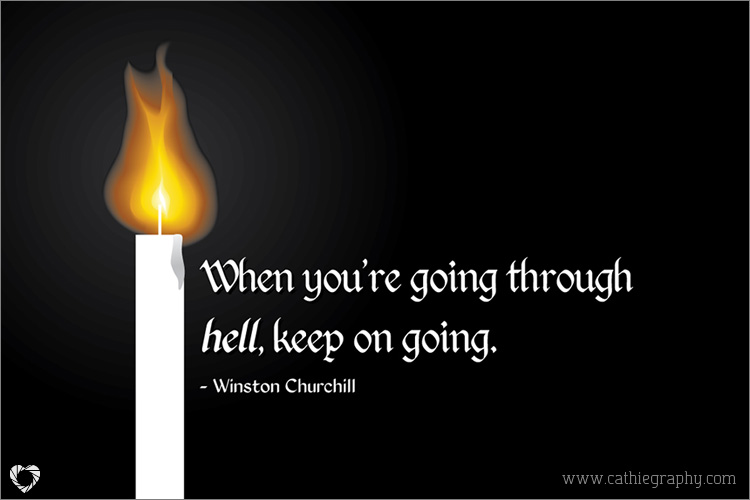
But every once in a blue moon, I do stop to ask God, “is there something you want me to say?” Usually there’s not. In my experience, God is far less opinionated about our lives than you’d think from listening to many Christians talk. But several times recently I’ve asked God, “is there something you want me to say?” And each time, I’ve gotten the same answer: “Tell them that I’m good.” Just that – “Tell them that I’m good” over and over. Which is fine and true and all, but doesn’t make for much of an essay. So finally I asked, “anything else?” And there was. “The only way out is through.” Ahh, now I’m beginning to see.

Here’s the deal; we’re all waiting to be rescued – aren’t we? I know I am – or was. I’ve pretty much accepted that there’s not a miracle or even necessarily a break just waiting around the bend. It’s a hard thing to make peace with. It’s probably a particularly hard thing for Christians to accept. From the time we are small we are raised on stories of the God who rescued the Hebrews from bondage in Egypt. The God of the Psalms who is our deliverer and will not let us fall. Who brings victory to us by his mighty right hand. A Savior with such healing power that simply touching the hem of his garment healed the woman with the issue of the blood. God is our savior, our deliverer, our ever present help in times of sorrow. The God who rescues is mother’s milk to us. And it’s all true. Every last bit of it.

But mother’s milk has to give way to meat. And it’s not a parent’s job to provide meat to a child for their entire life. At some point, we have to learn to go hunting for ourselves. And I believe firmly that we – Christians and humanity as a whole – have arrived at a time of having to grow up. God is with us. God will redeem whatever we go through, but it’s time for us to go through. Continue reading “God is Good”

Church and the Parable of the Talents

Our lesson today, ladies and gents, is the parable of the talents and what it can tell us about ways we Christians end up being like the bad servant:

“Again, it will be like a man going on a journey, who called his servants and entrusted his property to them. To one he gave five talents of money, to another two talents, and to another one talent, each according to his ability. Then he went on his journey. The man who had received the five talents went at once and put his money to work and gained five more. So also, the one with the two talents gained two more. But the man who had received the one talent went off, dug a hole in the ground and hid his master’s money.

“After a long time the master of those servants returned and settled accounts with them. The man who had received the five talents brought the other five. ‘Master,’ he said, ‘you entrusted me with five talents. See, I have gained five more.’

“His master replied, ‘Well done, good and faithful servant! You have been faithful with a few things; I will put you in charge of many things. Come and share your master’s happiness!’

“The man with the two talents also came. ‘Master,’ he said, ‘you entrusted me with two talents; see, I have gained two more.’

“His master replied, ‘Well done, good and faithful servant! You have been faithful with a few things; I will put you in charge of many things. Come and share your master’s happiness!’

“Then the man who had received the one talent came. ‘Master,’ he said, ‘I knew that you are a hard man, harvesting where you have not sown and gathering where you have not scattered seed. So I was afraid and went out and hid your talent in the ground. See, here is what belongs to you.’ Continue reading “Church and the Parable of the Talents”