Does God Get Angry?


If you haven’t contemplated murder, you ain’t been in love. ~ Chris Rock

“I will turn my beloved people over to the power of their enemies. The people I call my own have turned on me like a lion in the forest. They have roared defiantly at me. So I will treat them as though I hate them. The people I call my own attack me like birds of prey or like hyenas.” ~ God (Jeremiah 12:7-9)

Over the weekend I happened to come across an email I had sent my husband a couple of months after he left me and the kids. (Background here and here.) It was just a short note rejecting his request that we strive to be on friendly terms. Not that I wanted to be in conflict, but I wasn’t going to pretend to be OK with someone who had treated me the way that he had. In fact, I think it would have been really unhealthy for me to agree to be friend-like under the circumstances. I was very, very angry and I had a right to my anger. I had been betrayed, rejected and turned on by someone who I had done my best to love unconditionally through thick and thin. Emotionally, I was not in any condition to have anything more than a cold, barely cordial relationship with him. (As always, I am speaking of my own perspective here. My husband could give you an encyclopedic list of all the ways he feels I wronged him as well.)

During those days in between praying fervently for God to hit my husband with a bus, I was often grateful for the words of 1 Corinthians 13:5: “Love is . . . not easily angered.” It meant that there was room in love for anger. The two aren’t mutually exclusive. I hadn’t turned into a terrible, hateful, unloving person because of my anger. I didn’t have to be afraid of it or deny it or hurry up and get rid of it. In fact, being so angry was a legitimate part of being a loving person. I knew I would be able to work through it in time. Continue reading “Does God Get Angry?”

The American Race and Race

Gather ’round, folks. Auntie Becky is going to tell you a story. A metaphor really, about race in America. And about the American Dream.

Imagine for a moment, a long relay race where for generations it has been considered acceptable and in some cases even required to break the limbs of a one group of people trying to run the race. The people thought this was OK. After all, it wasn’t long ago that this group of people had been used as horses to pull everyone else’s carts around the track. At least they were free of that back-breaking work. Now, they just had to contend with some needed cobbling. To keep the race running smoothly. Make sure the people who have been running the race so diligently for generations don’t lose any hard-earned ground. Anyone who resists the “in group’s” right to break bones is killed, so that keeps everything on an even keel. Not a bad system, really.

Of course, people with broken bones do not do very well in the race. Pretty quickly there are people lying all over the place with broken bones and deformities from past breaks which were never set properly. Many people in that group will simply stop trying to participate in the race. Maybe even set up little shanty towns around the track to do the best that they can outside of the race. The more ambitious set up little lemonade stands along the track and play music for the people running by to keep themselves out of the darkest, scariest parts of the shanty towns. A few are fast enough to elude those who would break their bones, but these would be few and far between. The track is littered with those who tried to be one of the fastest few but got caught. Their broken bones and mutilated corpses remind the out group not to try to hard or rebel against the natural order of things.

Now, let’s say that after a very long time, once most of the people who are able to run the race are pretty well ahead, that people start to come to their senses and decide that it is wrong to break the limbs of the out group. So they ban limb breaking. From that point forward, a person’s success or failure in the race will depend on their efforts and abilities. Continue reading “The American Race and Race”

You are a beautiful woman . . .

Ok Gentlemen, if you could leave us alone for a moment, I have something I’d like to share with the ladies real quick. Well, I guess if you want to pass this along to your wife or daughter, you can stay and eavesdrop.

Now, ladies I don’t know about you, but it seems to me that as a culture we have not only fetishized flawless female beauty, we have made feeling bad about our bodies and beauty a virtue. Hopefully you are as lucky as I am and you have a husband who has managed to convince you that you really are beautiful and that the odd lumps of your figure are sexy rather than repulsive. However, I suspect that many women go through their whole lives not feeling entirely comfortable with themselves. Which is a shame.

I have heard that once upon a time it was generally accepted that 1 in 5 women would be classically beautiful. The other 4 could be comfortable in their plainness, or dowdiness or oddness and rely on the power of their personalities and femaleness to be attractive to the 4 out of 5 men who were likewise not going to win beauty contests. Today it seems that we all feel obligated to either achieve beauty or to feel badly about ourselves.

What is funny is that men do not seem to look at us this way. Continue reading “You are a beautiful woman . . .”

The Wisdom of Being Wrong

I have this idea that a big part of what is wrong with us as human beings is we don’t know how to be wrong. And it’s not only because we’re pig-headed fools. It seems to be something that’s hardwired into our brain. We know from research that people will go to great lengths to avoid facing facts which conflict with what they already believe. There are those who argue that this is what’s happening in our politics today. Or it could be that since we’re a nation of smart-asses, people who hate Obama are telling pollsters that they think he was born in Kenya just to piss everyone off. The world may never know. But the fact remains that there have been a lot of very good studies which have found that once we believe something to be true, it is bizarrely difficult to convince us that we are wrong.

Scientists think this is a perfectly reasonable survival mechanism which is shared by many animals as well. Experience is the best teacher after all. So once you experience something yourself or vicariously through someone with more experience, you learn lessons which you presume to be true. You stick to those lessons – maybe develop a way of doing things around them. And it usually works. Until your environment changes and you end up like a polar bear looking for an ice floe. Then you need to adjust.

Fortunately, if there’s anything that binds humans and bacteria together, it’s that we’re both fantastically adaptable. Frankly I think it’s a bit odd that we are actually surprised to find bacteria in inhospitable places. The bacteria are probably even more shocked that we showed up. By all rights, our physical capabilities should have kept us contained to temperate zones with enough moisture to allow for a year-round supply of food. You know, like the Garden of Eden was supposed to have been.

But that’s not us. We humans change things. We change the landscape and our locations and our clothes and bodies and even the songs we sing with glee. But changing our minds? That is one change we really don’t seem to like to do. A lot of us adhere to something my mom once told me: “I’d rather be wrong than change my mind.” (I’m pretty sure she was saying it in a “If Loving You Is Wrong, I Don’t Wanna Be Right” sort of way and not as an expression of unwillingness to admit error. But it was still funny.) Fortunately, we all know from experience that biology or no, it doesn’t have to be this way. Not only do humans change, we grow up. In fact, we can grow up the way other organisms just grow – for our whole lives. If we want to. But it all depends on learning how to be wrong. Continue reading “The Wisdom of Being Wrong”

Most Christian’s Opinions Aren’t Worth Two Dead Flies – But That Can Change

I like to say that I grew up in the “Easy Listening” phase of American Roman Catholicism. We sang “On Eagle’s Wings” with a guitar accompanist and hung felt banners around the sanctuary. My cousins attended a church that had alter girls and interpretive dancers. An opera singer who attended our church was sometimes allowed to lead songs and children regularly got smacked in the back of the head for giggling when she stretched to hit really high, screechy notes. Which was better than when her nightclub singer daughter sang and made us all feel like we should go home and shower after watching her squirm around singing about God and love in breathy tones.

Some of my sisters feel strongly that they were damaged by being forced to attend mass each week at this retro-grade institution. But honestly, my memory is of sermons that could basically be summed up as, “kids, listen to your parents and don’t fight with your siblings. And every one needs to stop trying to run each other over in the parking lot after mass.” For me it was about as benign an introduction to Christianity as you could hope for.

Which isn’t to say that it was entirely content free. Like all good Catholic kiddies, I attended catechism classes every Wednesday night for an hour all through grade school. I have an amazing capacity to completely tune out anything that doesn’t catch my interest, so I don’t have any idea what we did each week. But what I do recall is having to memorize things. We memorized prayers like the Our Father, the Nicene Creed and the prayer for confession. We memorized the 10 commandments, the beatitudes and the various works of mercy. It is entirely possible that we actually talked about what these things we were memorizing meant, but again, I wasn’t really paying attention.

The end result was that I couldn’t have told you why Jesus lived and died, but I did know that he told us to love each other and serve those in need. And as much as I love me some good theology, I’d say I got a better religious education than other kids who could explain penal substitution and use “Roman’s Road” to explain (their version of) the gospel. Continue reading “Most Christian’s Opinions Aren’t Worth Two Dead Flies – But That Can Change”

PMS, Reinterpreted

Do women tend to have higher natural emotional intelligence (EQ) than men? Most people think so although research hasn’t settled the argument yet. But if women do have higher EQ, I think I know the reason: PMS. (Men, you need to hear this, so don’t check out on me now!)

There’s this weird thing which happens with PMS. Every month you have a day or two where you are completely convinced that your life is awful, with no redeeming qualities, hardly worth living. You will find yourself collecting evidence to support this perspective. The money problems. The kid’s dirty clothes. That hole in the wall that’s needed patching for as long as the baby’s been alive. It’s all your fault, evidence of your failure. And it’s hopeless. You know for a fact that all those people saying things like “you don’t lose until you quit” are delusional unicorn-friending idiots. At some point you start to understand women who abandon their kids to smoke meth in a motel outside of Vegas with a truck driver. It makes perfect sense in fact.

But here’s the thing: while you are busy wondering if you actually have the cajones to go to the local truck stop and start talking up potential new boyfriends, it never, ever occurs to you that any of this is anything but gospel truth. It’s not until the next day when you discover for a fact that you are not pregnant that you realize – it’s just hormones! It’s not actually real. Continue reading “PMS, Reinterpreted”

Faith or Works? Both? Neither!

Remember when Christians used to argue over how many angels could dance on the head of a needle? Perhaps someone should have stopped to ask why angels would even want to dance on the head of a needle. I mean, if they weren’t dancing there because they had some desire to, getting them there to begin with would require some coercion. And really, should we be coercing angels into doing dumb things for our own entertainment? It seems like they were having all the wrong conversations back then.

I’m going to go ahead and posit that the old faith vs works debate is going to go down in the books as an equally misguided debate about what we are judged on. The reality about faith and works is that they exist in a symbiotic relationship with each other. True faith yields good works which increases faith so on and so forth. But if we’re actually going to be judged on the basis of either faith or works, we’re pretty screwed anyways.

Take works. How many “Feed the Children” commercials showing a small child climbing a garbage heap have you sat through without doing something? How many times has a friend or family member had financial problems that you did nothing to help with? How many homeless people have you passed by without giving them so much as a sandwich? If you are a faithful Christian, you have likely helped those in need on occasion – as often as you are able maybe. (If you’ve never done any of these things – or things like them – you may want to question your concept of yourself as a faithful Christian. I’m just saying.) But I know that I’ve sat through pleas for money to help get clean water to kids drinking sewage while licking cheezy-poof dust off my fingers. I’m gonna fail if we’re judged on works, I’m afraid. Continue reading “Faith or Works? Both? Neither!”

Mountain Climbing

Once there was a climber who set out to climb a mountain.  The word from those who had gone before was that the guru at the top of the mountain was God himself and that the closer you got to the summit, the more spectacular the views and the more satisfied your soul became.  At the bottom of the mountain, there were many paths to start from.  Different paths had different challenges and enjoyments.  The mountainside was dotted with cafes, inns and gathering places and many people enjoyed exploring the trail they had started from.  But as the elevation got higher and the air a little bit thinner, the trails all converged together into one narrow, difficult path.  This was the way to the summit.  This was the path our climber was determined to take.

The road to the summit was not as well traveled as the other trails lower down.  Everyone on the mountain claimed to be trying to reach the top, but few actually ventured onto the daunting path towards the summit.  The accommodations along the higher path were functional, but sparse and the travelers even sparser.  It was not uncommon to meet someone nursing a strong drink at a gathering spot along one of the lower trails who had been defeated by this arduous journey to the summit.  The few who made it to the top tended to be harder to locate, but when asked they all said the same things:  “Stay on the path even when it looks foolish and dangerous.  If you think you are lost, stop and wait until the path becomes clear again. Gather any food and supplies you find even if they are a burden to carry – you will depend on them later.  And don’t quit.  It’s worth it.”

Our intrepid climber knew it was a foolhardy journey to undertake.  But she had never found a comfortable spot on one of the trails lower down that satisfied her heart.  The amusements found there seemed unworthy of her full devotion and the people were often kind but they were not God.  They could not satisfy her heart.  So, she determined to climb the summit to meet God and satisfy the longing in her soul which would not allow her to make peace with lesser things.  Continue reading “Mountain Climbing”

Virtuous Vanilla Lip Balm, Jesus and a Prostitute

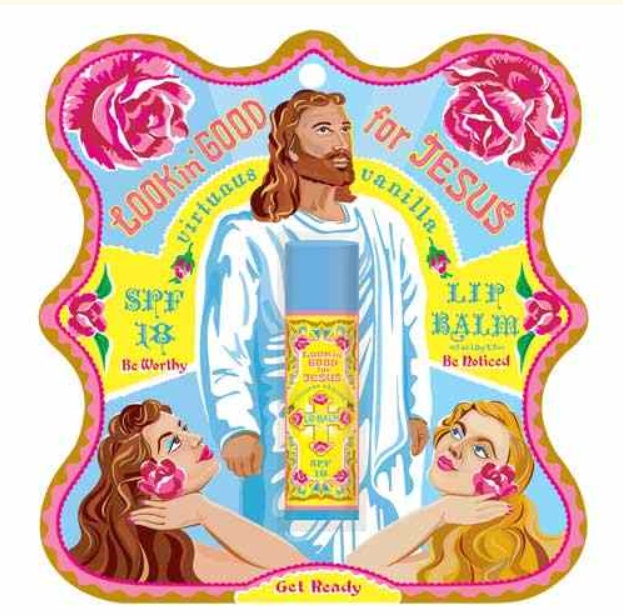
Once upon a time, a Christian entrepreneur got carried away and created a line of Jesus themed personal care products. The idea was to present “to-cool-for-school” unchurched types with an image of Jesus as irreverent, hip and ironic, and thus more acceptable. The result was this:


Of course, it’s possible that you’re not much of a flavored lip balm sort of guy or gal. Perhaps a “Looking good for Jesus” shopping bag is more your thing. Or bubble bath, hand cream, coin purse compact mirror and mini kit.

If you’re more of a dirty feeling person, you can check out the related line of products called “Wash your sins away” which includes towelettes, breath spray, lip balm and, of course, bars of soap.

Unfortunately for our stalwart business person, cautious Christian bookstores were uncomfortable with the pseudo-sexual overtones of the whole thing. They refused to stock the product line, despite an endorsement from a well known Christian Patriarchy leader. Desperate to empty reclaim the use of his third garage stall which was filled with product which had no place to go, the business person was forced to look for other markets. Eventually he found customers among the sort of small boutiques who cater to the “too-cool-for-school” crowd.

OK, I totally made that whole story up. Although you have to admit that my “failed evangelization tool” story is shockingly plausible.   Continue reading “Virtuous Vanilla Lip Balm, Jesus and a Prostitute”

The Secret of Life*

This is rough, and obviously abbreviated, but I think it’s just about right.

The secret of life – the great secret of life – is that what brings us real joy tells us who we are. God wants us to live lives of joy and has therefore put the blueprint for finding joy into our very being which is made in his own image. Since every good and perfect gift – ie what brings us real, lasting joy – comes from God, the more we know God, the more we will recognized joy. And the more we recognize what brings us joy, the more we will know who God uniquely created us to be.

But there is a forgetting that is part of being human, and we forget who we really are or how to find the blueprint for joy. So, we piece together a sense of who we are from our experiences, other people’s input, ideas we come across. Most of us struggle just to get to know this poorly reflected version of who we are. We rely on emotions whose meanings we only vaguely understand to guide our choices because the discomfort they create is so awful that any reasonable person seeks escape. We escape by seeking pleasures we know are harmful because they offer that respite from the discomfort our lives cause us.

One of the most important roles that religion has played has been to help us avoid and recognize when what we are being offered is a false version of what we really need in order to be joyful. Continue reading “The Secret of Life*”