Keeping Faith When Life is Good

524824_498440336890132_847551978_nIf you’re a regular reader, it’s probably hard to imagine a happy-clappy Rebecca, but honestly, I haven’t always been a broken, whiny, suffering Christian. In fact, for most of my adult life, I was pretty darn happy, although I never was very clappy. Unless there’s a good gospel-worship band going and I can get as clappy as the next gal.

Sure I had my ups and downs. Sometimes I was really unhappy and even fell into a serious depression once before. But those were passing phases, really. Most often, I was happy in the face of challenges and sometimes life was reasonably decent enough that I was simply content. Ah . . . those were the days.

One of the things I learned during those years was that I’m a much better Christian when things are going well than when they aren’t. As you may have noticed, when life really sucks – like way more than is normal for a life to suck, sucks – it doesn’t bring out the best in me, faith-wise. I get angry with God. I complain incessantly. I delve into despair. Bitterness crops up. I question every choice I ever made – especially the one to follow God. I feel betrayed. I complain. Did I mention that I get angry with God?

Yes, it is true that sucky times teach me a great deal. I grow in them. I’m sure it’s all for the good. Maybe. But really and truly, if you were to ask me when my walk with God is most faithful, most intimate and most life-giving, it would be during the good times. Hands down. And as is so often the case with me, it turns out that this is a little weird.

Many Christians who have had the experience of following God in hard times find that it’s actually easier to be faithful during those times. When life is crushing us, we are forced to depend on God completely. Not being able to do anything else, we may spend much more time in prayer, calling out to God for help. We rely on scriptures for comfort. And then when the clouds clear and life gets easier, and we don’t have to be so dependent, aren’t continually calling out for rescue and don’t need so much comfort, many people’s relationship with God kind of falls off. Continue reading “Keeping Faith When Life is Good”


Excuse Me While I Get Naked With Y’all

One of the things I have learned is that your gut always tells the truth. It’s not always right, but it always tells you the truth about what you really, deep down believe. Which can be a useful thing to know. Often we know something, we intellectually assent to it, we try to live out of it and we fail continually. Because you can think your way to right belief, but knowing it deep in your gut is another thing. It’s really only when you know it deep in your gut that it becomes real and you can live out of it successfully.

The problem most people have is that their gut level reaction is often in conflict with what they think or know is right and so they push it away. (Think of the person who says she isn’t racist, but has either never been honest with herself or made excuses about the fact that her stomach clenches up when she finds herself near a group of minorities.) I’ve found that once I allow myself to be aware of my gut level reactions, I can deal with whatever underlying issues they are pointing me to. And in time, what my gut says will start to line up with what my brains says. It’s a good thing.

confessionNow, I bring all of this up because I have a confession to make and I’m going to ask y’all for some help with it. You see, about a month ago, I was at a meeting where the leader mentioned in passing the wholeness that comes from knowing down to your bones that God is madly in love with you. And my gut went all woo-woo-gah-fargle-pthhhh on me. I almost started to cry. Because my gut was telling me that I at a deep level, I don’t believe God loves me. It’s true. And I can write here talking about God’s love. And I can pray over a person – an enemy even – and be amazed to discover the deep love God has for them. But it’s a truth that I just haven’t been able to accept for myself.

It makes no sense. I know that I love God, so God must love me – “we love because God first loved us”. Continue reading “Excuse Me While I Get Naked With Y’all”

What’s So Great About a Bible Hero?

Did you know that research has found that people in interracial marriages report that marriage is more difficult than they anticipated and are slightly more likely to divorce? As someone in an interracial marriage, I can tell you why that is. Our normals are different. And that causes problems.

By normals, what I mean is what we each assume is right, good and normal. All couples deal with this. You think it’s normal to walk around the house in your undies and your beloved wouldn’t dream of walking out of the bedroom with out his shoes on. He thinks spaghetti is served with velveeta melted on top and you’re not a lunatic, so you recognize crazy when you see it.

Most of the time we are able to adjust, compromise and accept that each of us thinks the other person is certifiable in some way. But people who marry people from other races tend to face much deeper differences in what they think of as normal. African American’s relationship with authority is much different, more complicated and often more rigid than a white American’s. (Oddly enough, attitudes towards authority just don’t come up much while dating.) A woman I know married a man from Peru and was shocked to discover that he expected her not to speak with men she didn’t know when he wasn’t present. He was shocked that she would even consider doing such a thing. Another woman I know married a man from East Asia and learned that they had very different ideas about secrets – he felt perfectly comfortable telling their children lies about some important things to protect them from hard realities. Authority, gender, secrets – when people from different cultures get married, they often discover that they are in conflict about some very deep things.

What makes interracial relationships so difficult, I think, isn’t just the conflicts that come out of these differing ideas of what’s normal. It’s that you are constantly being forced to examine and question the underlying assumptions you have regarding really deep things. And we’re not good at that. We can barely admit when we’ve taken a wrong turn and gotten ourselves lost. Considering if maybe your entire concept of the role of fairness in relationships and society is off is painful and confusing. Add in the fact that there isn’t necessarily a “right” answer to questions you always used to know the right answer to and  . . . . arrrrgh!

Sometimes you just want to tell the other person to leave you alone – life was just fine before you came along with your crazy ideas and made me question the existential meaning of housekeeping! (And yes, I do know that in my case, some of this is driven by the fact that my husband and I are very intense people who completely over-think everything. But really, that just means we can define what we are arguing about in greater detail than most people!)

I happen to think that as hard as it is, couples in interracial relationships are doing hard, but good, important work. The sort of work the heroes of the bible did, in fact. Wait . . . what? Interracial couples challenging each other’s ideas about normal is just like the bible heroes? How’s that for a complete non sequitur! Allow I to explain. Continue reading “What’s So Great About a Bible Hero?”

Condemnation is One Curse Word I Won’t Say

When my oldest son was 2 1/2, we were driving home one day and from the backseat I heard a little boy voice say, “Fuck!” Thinking quickly, I told him, “that’s right honey – truck! There’s a truck over there.” He repeated “fuck” several times and I kept saying, “that’s right honey – truck!” Finally with a note of confusion in his voice he said, “truck?” Yup. Truck.

Now, where ever would a sweet 2 year old kid of mine ever hear such a word? From me, of course. I do try not to swear (much) in front of my kids, but it happens. Most days. I know you think I should at least have the decency to feel guilty about it, but I don’t really. I swear. I like swearing. Swearing plays an important role in every language that’s ever existed. Sometimes nothing but a well planted swear word will do.***

Although I’m perfectly comfortable with swearing, there is a verbal tick I used to have that I wanted to get rid of but just couldn’t seem to manage. I frequently used God’s name as a curse word or as part of a string of curse words. It was so automatic that I couldn’t seem to stop. It seems like a fairly minor thing, but it really bothered me. Don’t take the Lord’s name in vain being one of the commandments and all (yes – I know the command can be understood to refer to something different, but still). 

There was a time in my life when my inability to stop using God’s name as a curse word made me feel awful. Like a terrible, awful person of low character and lower self-control. Now here’s the thing about a person feeling like an awful, terrible person: that feeling never comes from a Godly place. Scriptures tell us that it is Satan’s job to accuse us – that is to offer an explanation for or story about our behavior which makes us look like terrible, awful people. Feeling like a terrible, awful person is what happens when we feel condemned. But “no condemnation now exists for those in Christ Jesus”. 

The reason the enemy loves to use the tool of condemnation is because it hides the truth of who we are from us. You and I and every other human being is an image bearer – one who reflects God himself. And the enemy knows that if we ever discover this truth and learn to live out of it, the jig is up. All his work will be destroyed. But if he can convince us that our sin and weakness defines who we really are, then we may putter along, trying to fight our urge to sin but never really owning, much less living out of the glory which is in us. Now, sometimes the enemy will overplay his hand and the condemnation a person feels for their sin will actually lead them to seek God. But that’s fairly rare and it’s such an effective tool most of the time that it’s well worth the risk for the enemy to keep condemning us. (This dynamic is also why we are not supposed to judge. Even when we are correct about another person’s sin, when we judge, we are doing just what the enemy does. We are telling someone that their failure is a reflection of them. It’s not. It’s a reflection of sin which is not part of who we actually are.) Continue reading “Condemnation is One Curse Word I Won’t Say”

Unconditional Love Brings Death

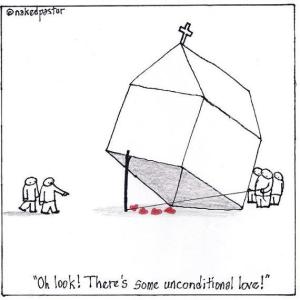
Unconditional-LoveI’ve come across a number of Christians lately who are questioning the impulse to elevate love above any other concern. Love is too soft and squishy, they say. Love becomes an excuse to avoid hard things like confronting sin and enforcing discipline. One writer even asked if we are in danger of making love an idol. (Perhaps he hasn’t gotten to the part where the bible says that God IS love?!?) 

I have something to tell you about people who say that love is squishy, soft, a cop-out: quite clearly, such a person has never actually attempted to love unconditionally. Loving unconditionally is the hardest thing any human being can ever try to do. Confronting sin? Upsetting friends and family? Setting boundaries and rules? Pffftttt . . . . Those are the simplest, most natural things in the world for the fallen human mind to do. Loving unconditionally? That WILL DESTROY YOU. It will cost you EVERYTHING. You will DIE if you try to do it. 

Then Jesus said to his disciples, “If any of you wants to be my follower, you must turn from your selfish ways, take up your cross, and follow me.” ~ Matthew 16:24

These Christians who warn against love are right to be afraid of it. But not because it’s soft and squishy. Just the opposite. Unconditional love is the hardest, heaviest cross a human being can bear. It sent Jesus to his death. He warned us that it would divide “father against son and son against father, mother against daughter and daughter against mother, mother-in-law against daughter-in-law and daughter-in-law against mother-in-law.” 

In fact, unconditional love is so hard and so dangerous that I’ve had mature, devout, loving Christians who I respect warn me against it. One man told me to never ask God to teach me to love people the way he does. It’s impossible, he said. Another woman told me the same thing about the sort of love described in 1 Corinthians 13. It’s impossible.

Jesus said to them, “With people this is impossible, but with God all things are possible.” ~ Matthew 19:26

Continue reading “Unconditional Love Brings Death”

Screaming Like A Banshee, How Not To

Once upon a time, self-mastery/self-control was a highly valued trait for a Christian to have. Unfortunately, what passed for self-mastery was too often little more than repression and denial. Of course, neither repression or denial are held in very high esteem these days (and for good reason!). But the downfall of repression and denial has in turn lead to the virtue of self-mastery being downgraded from a highly sought after virtue to barely an after-thought in the Christian life.

The reason that self-mastery has traditionally been held in such high regard among Christians, is because it is held in high regard by scripture. 2 Peter 1 connects self-control with partaking of God’s divine nature, for example. Self-control is one of the fruits of the Spirit in Galatians 5:232 Timothy 1:7 lists self-control alongside power and love as the result of God’s spirit. Proverbs 25:28 says that a person without self-control is like a city whose walls have been breached. When Paul was imprisoned by Felix, he taught “righteousness, self-control and the judgment to come” when asked to preach on faith in Jesus. I could go on, but the point is that even though we’ve rightly tossed out the practice of repression and denial, we ought to cling to and work to develop self-mastery as part of our Christian faith.

So . . . the question becomes how to cultivate self-control once repression and denial are no longer desirable tools. It just so happens that self-control is something I have spent a lot of time helping my children to develop over the years. Unfortunately for me (and everyone’s eardrums), self-control didn’t come naturally to any of my children. In fact, it often felt like trying to teach a fish to walk. At the moment, it’s my middle daughter who is receiving intensive tutoring on the subject. She’s the one, if you recall, would rather miss a meal than compromise on where to sit at dinner and who responds to a light swat on the rear with shrieks of “help, I need immediate medical attention!” So we’ve got our work cut out for us. But progress is being made.

What I do have going for me is 18 years of experience teaching decidedly uninterested, unreasonable and hysterical children the fine art of self-control. And so I figured I would share this week’s lesson with y’all as well. Just in case it might help someone.

The first step I’m teaching Miss-screams-a-lot is to start by simply identifying how she is feeling. Like all of us, this child has a feeling, comes up with reasons to justify that feeling and then believes that those reasons are the cause of her misery. Thus we are treated to a barrage of “she did this and he did that and they’re being mean to me and everyone’s always mean to me and I’m sick of it” several times a day which no amount of reasoning can do anything to stop. We’ve talked about this before – we like to think that we react for perfectly good reasons, but the reality is that we react and then come up with perfectly good reasons to justify it. By starting with the feeling, rather than the provocation, we addressing the actual cause for the lack of self-control. Continue reading “Screaming Like A Banshee, How Not To”

God’s Judgment Coming Through Disasters

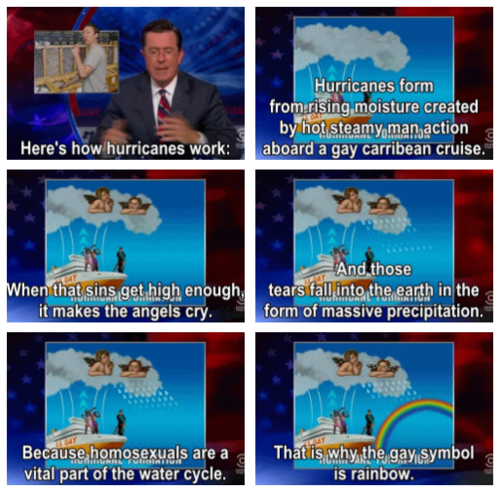
gay hurricanesEver stop to think that maybe God’s really upset with open fields? And farmers? Seriously. Do you have any idea how many tornado’s go rampaging through open fields every year? We all pay attention when a tornado hits a populated area or a pro-gay church gathering, but the vast majority of tornado’s hit open fields and farm land. And since (according to some people’s thinking), natural disasters are a sign of God’s wrath, then God must have some big beef with open fields and farm land – right?

Or did you ever think through the implications of the fact that our planet couldn’t support life if it wasn’t so dynamic? Without geological process which lead to earthquakes and volcano’s and even weather events like hurricanes doing their part, life could not exist on Earth. So if destructive weather events and earthquakes and volcano’s and such are the result of man’s sin (the teaching of some folks), then if everyone stopped sinning, the planet would become stagnant and we’d all DIE. Now there’s a reason to carry on fornicating if ever there was one!

OK, OK, I’m being silly. Piper and Driscol their ilk not withstanding, I think all reasonable people understand that natural disasters are the result of the normal processes of the planet and not sent by God to punish us for pissing him off. And yet – believe it or not – I don’t think the “Hurricane Katrina was caused by Mardi Gras” people are entirely wrong to think that there is a link between God’s judgment and natural disasters. In the bible, natural disasters are sometimes linked quite explicitly to God’s judgment. But I don’t think it works the way some people think it does.

First of all, major weather events and calamity aren’t caused by people sinning and making God angry. Earthquakes, hurricanes, tornado’s, volcano’s and the like were happening long before we were here to piss God off. And life on earth does depend on these dynamic processes. The bible says that God “causes the rain to fall and the sun to shine on the good and evil alike.” Rain can mean flood and sun can mean drought, so this isn’t just a statement indicating blessings, but also disaster. So both good weather and bad weather will happen regardless of whether people are good or evil. Continue reading “God’s Judgment Coming Through Disasters”

Self Righteousness, Election and Healing

How’s this for the most pretentious opening line I’ve ever used for a blog post?

So, I was talking with my therapist yesterday . . . .

OK, maybe pretentious is too strong a word. But yes, really, I was talking with my therapist yesterday. Because when you’re going through so much and your support system is failing like a fat woman’s bra and you have a bunch of kids who might be adversely affected by watching their mother break into a million tiny shards, the responsible thing to do is to get a therapist. I’m just hoping I can get my shit straight before they start coming after me for all the co-pays, but that’s another story.

Anyhow, my therapist was going through the 8 types of emotional experiences/stressors which can end up being stored as unresolved issues in our autonomic nervous system. As she went through, I stopped her and said, “that one – unmet needs. That’s exactly what I’m hung up on right now.”

We talked a bit about some of these unmet needs – little things like the need for comfort, belonging, affirmation, knowing that someone gave a crap if I ended up as a self-sufficient adult or a hobo. Stuff like that. And for a moment, I started to feel that strangely narcotic thrill of self-righteousness. I’m sure every human knows just what I’m talking about – that simultaneous feeling of being superior and victimized. The one which allows us to use other’s wrongs to elevate ourselves while condemning them.

There’s something about feeling self-righteous which is so  . . . . satisfying. Ego boosting. Seductive, even. Over the years I’ve noticed that I can let go of many things pretty easily, but there’s something about this feeling of self-righteousness which feels almost like being in a warm embrace. Letting go of it feels like a loss in a way that letting go of anger or desire or frustration just doesn’t.

But as I sat there in the momentary thrall of this feeling of self-righteousness, my spirit whispered, “those people who didn’t comfort you, who comforted them when they were small and hurting?” Which brought me and my gloating pity-party up short.

The reason I think self-righteousness is so enticing is because it feeds on the knowledge that we’re right. We’re (at least in our own minds) innocent – or close enough to innocent to count. The other person is guilty. Not just guilty, but unjustified as well. What’s wrong with simply pointing out facts?

But the reality is that the other person has an identity that has nothing to do with what they did or did not do for me. No matter how satisfying it is to slap the name tag “Guilty, Unjustified” on their chest, their true identity is actually “Human, Image Bearer, a little bit broken”. Continue reading “Self Righteousness, Election and Healing”

Life as a Video Game

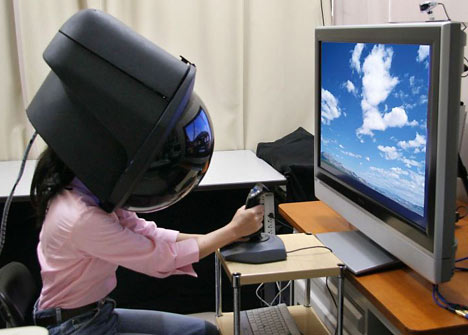
There are scientists working with teams at thegamingmonitor.com right now to try and figure out if the universe is actually a massive holograph. Frankly, I’m not really sure what it would mean if it turns out it is. As long as our only awareness is within this realm, I don’t see how knowing that I’m stuck in an intricate projection would change anything. But I do have my own unprovable theory about technology and the nature of our lives which I think could be useful. It’s this: what if we thought of our lives as us taking part in a massive, intense, virtual reality video game? Now, I’m no gamer myself, so I’m sure I’m going to miff some details here, but bear with me.

See, I think that when we become embodied, it’s like starting to play this virtual reality game. The physical realm is the setting for the game. One of the game’s features is that it’s so all-encompassing, we tend to forget that it’s not reality (or at least doesn’t represent ultimate reality which would be the spiritual world). It would take some of the best gaming monitors the world has ever seen, times 100 to even get close to that immersion. It seems likely that some of us retain the memory that we’ve entered into this alternate world for a while when we are very young. Thus the common beliefs/reports that infants and small children can see angels.

Like a video game avatar, everyone gets a body to use during their time in the game. While each of us bears the image of God, these bodies are shaped by a nearly endless array of genetic differences, environmental exposures, quirks of growth and such before we are born. Add the influence of external factors – circumstances, relationships and parents and each of our avatars carry God’s image in completely unique ways as we move through the game.

Like all games, this one was made with challenges, risks and even unavoidable traps and dangers. In the Christian tradition, there has been a tendency to think that prior to the fall, the world was perfect. Unless you were a plant, because everyone – even the tigers and vampire bats – ate you. But the reality is that God declared the created world “good”, not perfect. All of the evidence we have points to the reality that there have always been earthquakes, sickness, droughts and animals who think we look like a tasty treat. But if we remember that this life is a game, then we can also remember that any game worth playing has challenges and risks or its just not worth playing. Part of what happened at the fall seems to have been that we decided that life – including ourselves – wasn’t good enough. But even with flesh eating bacteria and spiders the size of our heads, the world was made good and it still is today.

I think that the story of the creation of man can be the story of the day when God said to adam – humanity – “come and see this place I’ve made for you to play in. It has plants and animals, day and night, mountains and valleys for you to enjoy and cultivate. I’m going to start you off in a garden where you can tend to the land and the animals there to start off with. You will be paired as male and female to have children so that everyone can get a chance to play the game and learn and grow there. Some of you will play the game for many seasons and some of you will kind of pop in and out. At the end of your turn, we’ll take a look back and see how you did. There are risks, of course, but I made you very good. You’ll figure out how to advance in the game to deal with these risks over your generations.”  Continue reading “Life as a Video Game”

The Gift of Delayed Grief

My early twenties weren’t exactly a stellar time. Within a short period of time I was raped twice. I found out I was pregnant shortly after I decided to take Jesus’ words that it’s better to enter the kingdom maimed and had broken up with then boyfriend. The people around me didn’t exactly rise to the occasion. One woman I told about one of the sexual assaults told every-freaking-body. A man she told became so belligerent towards me that I had to interrupt his screaming rant to let him know that if he laid a hand on me, I would call the police and have him hauled away. One of my dearest friends died after a life-long struggle with a rare blood disorder.

I had been studying to become a high school English teacher, but would now need help so I could complete my student teaching in order for that to happen. Instead, I was sent out into the world without so much as a chair to sit in or a bed to sleep on. I became homeless and wound up in a homeless shelter/half-way house for single mothers. My roommate was an orphan who stole a ridiculous amount of money from me. The other women there were children of drug addicts, forced out by violent step-fathers, recovering from addictions themselves, etc.

Some of the people around me felt free to demand that I go into hiding and then place my child for adoption so my siblings, relatives and community wouldn’t know of my shame. (The idea that perhaps a person who has already had their right to self-direction grossly violated shouldn’t be told what to do with her own baby didn’t register, of course. And no, this wasn’t the ’50s. It was the mid-90s)

After I had my son and decided to follow God’s leading and raise him myself, family and friends refused to have anything to do with me. Some went so far as to tell me directly that I wasn’t welcome to come around anymore – particularly if my son was with me. I did manage to eventually finish my degree, but what sort of work to pursue with a degree in Literature and Communications still eludes me. I was poor, alone and directionless beyond knowing that I needed to care for my son.

There were a few brighter spots. My then 16 year old sister was supportive and actually happy about her new nephew. A local church held the only baby shower I had until a couple of my husband’s friends’ wives threw a spectacularly under-attended shower for me when I was pregnant with my 5th child. So, at least I had a stroller when my son was born. Continue reading “The Gift of Delayed Grief”