The Power of Good vs Evil

The other day, two very different news stories caught my attention. The first was the news of a young man shooting people at a mall in Oregon, killing two shoppers and himself. The other was news that the mother of football player Jerry Brown extended forgiveness to the teammate whose drunk driving caused her son’s death. I was struck by the contrast the stories presented. But also by the likelihood that the way we think about these two very different events reveals how little we understand the nature and power of good and evil.

It is seen as almost a given these days that these are dark times we live in. The world is going to hell in a handbasket and may never fully recover. Pessimism about the state and trajectory of things is practically the default position. However, a proper understanding of the power of good and evil reveals something entirely different going on. For example, which event will have greater impact: the shooting at a mall or the mother who forgives? The mother’s forgiveness. By a long shot.

Odds are excellent that you are familiar with the bible verse which says that God will visit the sins of the father onto the sons. I had always heard it was to the 7th generation, but in scripture it says to the 3rd or 4th generation (Exodus 20:5). However, not nearly as much attention is paid to the fact that scriptures say that when we are loving and obedient to God, those blessings will be passed on through 1000 generations (Deuteronomy 7:9, Exodus 20:5). That is why no matter how dark the times appear to be, good is guaranteed to prevail. It is so much more powerful than evil. When evil enters into the system of humanity, if you will, it will do several generations worth of damage. But when good enters into the system, its benefits will remain pretty well indefinitely. And that is why despite all the attention paid to evil around us, it is not only rational to be hopeful about our world, but it’s irrational to be as pessimistic as we are. Continue reading “The Power of Good vs Evil”

Why I don’t consider abortion when voting

Let me be clear up-front: I do not support a right to abortion on demand. In fact, if I were made ruler of the universe, I would make abortions enormously difficult to get. Because I’m a mean and cruel woman. No, not really – I’m actually very kind and empathetic. But I am in agreement with Mother Theresa: “it is a poverty to decide that a child must die so that you may live”. I don’t think abortion is an answer to what is really a societal failure. I don’t only oppose abortion from a pro-life perspective. I think abortion is bad for women, worse for relations between men and women and displays a level of animosity towards women as they are – people whose bodies can start new life – which is evil and vile. If we have a society where the normal functioning of a woman’s body regularly ruins women’s lives, we’re doing it wrong. And abortion doesn’t do anything to fix that – it simply enables it. Nearly 60% of abortions are influenced by pressure from fathers, husbands, boyfriends or others with power in a woman’s life. That’s not empowering. Nor has ready access to abortion resulted in a world where people who shouldn’t have children don’t as abortion proponents used to argue. Far from it. And yet . . . the issue of abortion has nothing to do with how I vote.

Yes Democrats not only support abortion rights, but celebrate them the way most of us celebrate Grandpa’s 90th birthday. But despite using the abortion issue to garner votes for the last 30 or 40 years, Republicans haven’t and won’t do anything to stop abortion either. Sure, they’ll fiddle around the edges and I’d much rather live in a country where doctors don’t deliver a baby up to its neck before suctioning its brains, crushing its head and completing delivery. But show me one child who is alive today because we banned “intact dilation and extraction”. It’s a symbolic victory at best. The reality is that for all their rhetoric, the Republicans have shown no more willingness to do something about Roe v Wade than their Democratic opponents. If anything, I can at least give the Democrats credit for being honest about their support of abortion as birth control. But voting for someone simply because they claim to be pro-life does nothing what-so-ever to advance pro-life policies. It’s just giving my vote to the person who has set their dog-whistle to the right pitch.

Another reason abortion isn’t a factor in my voting is that abortion is only marginally a legal issue. 1.2 million women have abortions each year. By some estimates, one in three women will have an abortion in her lifetime. Including a good number of women who are Christian, pro-lifers. That’s a social problem. You don’t fix social problems with laws. Social problems get fixed with people. Continue reading “Why I don’t consider abortion when voting”

“What is truth?”

So, are you sick of the arguments yet? You know the arguments – Romney vs Obama. “Job Creators” vs Inequality. Creationism vs Evolution. Pro-Choice vs Pro-Life. Old Fashioned vs New Fangled. Text Speak vs Grammar Nazi’s. Toilet Seat Up vs Toilet Seat Down. Whatever it is, if we can figure out two ways of looking at an issue to divide ourselves into, we do it. And then we argue and argue and argue. We refine our arguments and wonder what the hell is wrong with the people who don’t agree with us. But aren’t you sick of it?

I remember years ago an older, wiser friend told me, “arguments don’t work. You never change someone’s mind through arguments.” At the time I was a bit flabbergasted. If we didn’t argue, how would the other person know they were wrong? And if we can’t get everyone pretty much on board, how do we keep the world from going to hell in a hand basket? I mean, what was the alternative?

Of course, today we have reams of research and endless gigabytes of internet conversations to prove that what my friend told me was true: arguments don’t work. They rarely change anyone’s mind. And I think all but the most die-hard believers are starting to get sick of them.

So what is the alternative to argument? Do we just agree to disagree – you have your opinions and I’ll have mine? And what about truth? Aren’t some things just true and shouldn’t we stand up for and advocate for them? If we can’t argue and persuade our way into some consensus about what’s true how can we function together to get anything done? The live and let live concept sounds fine until we need policies to get the economy going or fix serious social problems. Then what? Continue reading ““What is truth?””

It’s Becoming a Wonderful World

I wrote this for the 10th Anniversary of 9/11. I think it bears repeating.

Christians know and will sometimes actually say that Jesus won. But I don’t think many people fully appreciate how true that is. 2000 years ago, Jesus preached a radical message to turn the world upside down. In God’s Kingdom, the first would be last and the last would be first. Oppression would loose its grip, the suffering would be comforted, and we would be servants to the least. Jesus was speaking this into a world where power was absolute, life was cheap, illnesses could not be treated or cured and women had no rights or respect. In order to appreciate the victory that Jesus won, let’s just take a look at the world we live in today.

We now live in a world where the most powerful feel an obligation towards those most in need. The most powerful people in the world actually sit down together and make plans to relieve the suffering of impoverished people all over the world. The Romans barely gave a thought to the poor in their own empire much less starving people beyond their borders. The idea itself would have been absurd. Right now, Bill Gates – one of the most powerful, wealthy men in all of human existence has dedicated his life and wealth towards helping to alleviate suffering around the world. Do you realize how astounding that it? That is a victory for the kingdom way!

In the most powerful parts of the world today, human rights are seen as a non-negotiable good. In Jesus’ day, there was no freedom of speech. All of the apostles were martyred for practicing freedom of religion. Property rights existed only for the wealthy and powerful – no one else had much property to take! There were no laws in place to protect people from exploitation and fraud – these were normal ways of doing business. Slavery was accepted and the economy depended on forced labor. Continue reading “It’s Becoming a Wonderful World”

We’re in the Last Days

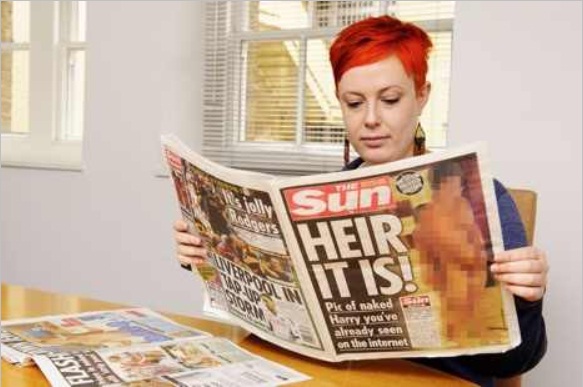
Forget the re-settlement of Israel or all the weird astronomical alignments happening this December, if you want real proof that we’re in the last days, look no further than the spread of Prince Harry’s nudie shots around the globe. Can you imagine telling people in colonial India or America that the day would come that people everywhere would see the Prince of England in the … Continue reading We’re in the Last Days

Bloggy Linky Goodness

Well, it’s been a slow week around here as you might have noticed. Next week will be different, but you’ll have to head down to the bottom of this week’s Bloggy Linky Goodness to find out more about that. In other news, I shaved my legs and pits for the first time in months. Most exciting thing to happen around here in a while, I tell ya!

But I do have some good writing/reading for this week’s Bloggy Linky Goodness to share with y’all:

Radical Practice Needs Deep Roots in Doctrine I love synchronicity – great minds think alike and all that. This beautiful post by Jonathan Wilson-Hartgrove at The Everyday Awakening explaining the gospel, suffering, atonement theology and more reads like if you took my own posts on suffering, the church and the sacrificial death of Jesus and put them into one post with much more skill and clarity than I have. Really great stuff. Continue reading “Bloggy Linky Goodness”

“High Priests of Caesar’s Court”

I came across a post by Greg Boyd today which I think makes a great follow-up to my post earlier this week – Our Faithless Culture Wars – that I hope you will go read. The choice excerpts for me:

We sadly assume our highest calling is to be the high priests of Caesar’s court, telling it how God allegedly wants it to spend its money.

Of course, being the high priests of Caesar’s court means you’ve got to get into the messy complexity of this court. How do we know that fighting for money to go to recreational facilities is the right thing to do? Maybe fighting for more funding for schools, or housing for the poor, or for more and better public transportation is a better fight. And what about the unlivable low minimum wage, or the lack of adequate shelters for the homeless, or the increasing number of people who lack basic health coverage, or the inadequate presence of police in dangerous neighborhoods? As the high priests of Caesar’s court, we have to make these tough decisions — and there’s only so much money to go around.

Not only this, but every action creates a reaction, and as Caesar’s wiser and more caring counselors we have to be experts about all of these things. For example, it certainly feels wise and righteous to insist on higher wages for workers. But are we sure this won’t force many small business owners to fire workers, thereby harming the poor more than helping them? And it certainly feels wise and righteous to insist U.S. troops pull out of Iraq right now. But are we sure this won’t result in a greater bloodbath than there already is over there? And it certainly feels wise and righteous to insist on preserving a pool for inner city kids, but what if the money for this has to be taken from classrooms, requiring that some teachers be let go, resulting in a poorer education for these kids? Is a pool more important than education?

It’s all very complex and ambiguous, but once we position ourselves as Caesar’s high priests, we have no choice but to wade through it all. Continue reading ““High Priests of Caesar’s Court””

It’s the Prime Directive

Yesterday, I saw a blog post by an atheist asking, “If I had the power to save everyone at the theater that was just shot up because I was all-powerful and all-knowing, and I didn’t do it, wouldn’t I be evil?” The old theodicy question – how do we explain a world of evil if God is all loving? It’s a legitimate question. And one that we have a hard time answering well. So, I was thinking about that atheists’ question last night while laying in bed. And then because I was drifting off to sleep and thoughts become more slippery and less reality tethered as you drift off, my mind wandered to ants. You see, my daughter Sophia had spent some time last night watching an ant colony in the rocks in front of the house. She tried to convince me to let her bring out some sugar for them – probably so she could watch ants carrying sugar crystals. I told her the ants didn’t need any help from us – they do just fine on our own. Partway to sleep, I thought about ants preparing to go off to war against another ant colony while Sophia was watching. What if she could step in to stop it? Would she? Should she? And my mind slipped back to that question – “If I had the power to save everyone at the theater because I was all-powerful and all-knowing, and I didn’t do it, wouldn’t I be evil?” Would Sophia be evil if she didn’t step in to stop an ant war? And just then the words “it’s the prime directive” popped into my head. Which woke me right up.

“Honey, what exactly is the prime directive again?” I asked my husband whose dream is to have us wear our federation uniforms on a replica of the deck of the USS Enterprise cum entertainment room.

“You can’t interfere with the internal affairs of any civilization in any way, for any reason.”

“And if they are getting ready to destroy themselves or do something really awful?”

“They have a right to their own stupidity,” he answered, “grmpzzzzzzz . . . ” (I think he’s kind of used to me asking strange, random questions when he’s half asleep by now.)

I lay back down thinking that I should go to that post and leave the comment, “it’s the prime directive, dear.”

Now, to be clear, I’m no deist. I don’t think that God created us and is just sitting back watching from a nice, heavenly vantage point. The bible and the existence of Jesus and many of our own lives all point to the reality that God is intensely interested in and invested in us. Like Captain Kirk, God has violated the prime directive many times. However, I have been thinking for a while that our understanding of God’s relationship with us is almost certainly skewed and needs adjusting. Continue reading “It’s the Prime Directive”

Our Faithless Culture Wars

A while ago, I finally realized that I needed to take Jesus’ teachings much more literally. He said, “don’t judge” and I said, “I’m not judging, but clearly some things are wrong. It’s not judging to say that.” He said, “love, pray for and serve your enemies” and I heard, “love the sinner, hate the sin.” He said, “do not resist the evil man” and I signed petitions against groups and politicians in order to protect Jesus’ values. Jesus said, “so do not worry, saying, ‘What shall we eat?’ or ‘What shall we drink?’ or ‘What shall we wear?'” and I wonder if we should make plans to attend the financial planning series the church is holding on Thursday nights. Jesus said, “the first shall be last and the last shall be first” and I work really hard to be at least in the top quintile in everything I do. See the problem here?

So, haltingly and stumblingly and often failingly, I have tried to unlearn the ways we do things here in the world and adopt the Kingdom way of doing things. What I have learned in the process is that what we see as “standing up for Jesus” or “hate the sin, love the sinner” is really a form of faithlessness. We don’t trust God enough to be able to work things out according to the ways that Jesus told us to do them. We fight and opine and advocate because we are convinced that without our help, God won’t get his way. We think that all that talk about not judging and not resisting and not worrying are good – so far as they go. But there are important issues at play here. If we don’t stand up and fight, we could lose! We could be eating cat food in retirement. “God doesn’t get what it’s like down here” is what I’ve sometimes told myself. Only that’s ridiculous – God made “down here.” He came down here and suffered the worst we could throw at him. And God wins. Always, everywhere. Period. Amen. The reality is that every time I judge or fight or worry or try to keep my position, I’m throwing my lot in with the losing side. Really. Think about that and then think about our culture wars and you can start to see why “the church” has failed so miserably in fighting them. And even more alarmingly, how breathtakingly faithless we are. Continue reading “Our Faithless Culture Wars”

Brooks, Dreher, DeYoung et al vs “Why I Hate Religion, But Love Jesus”

True dat!

Perhaps you have heard about the time religious rulers asked Jesus what the greatest of the commandments was and he answered, ” ‘Hear, O Israel, the Lord our God, the Lord is one. Love the Lord your God with all your heart and with all your soul and with all your mind and with all your strength.’ The second is this: ‘Love your neighbor as yourself.’ There is no commandment greater than these.”  Did you know that it wasn’t Jesus but another popular rabbi of the time, Rabbi Hillel who was responsible for popularizing the golden rule among first century Jews?  Jesus would almost certainly have been familiar with this man and his teachings.  (Rabbi Hillel was also well known for teaching against judging others and opening the study of the Torah to those who were interested but could not pay.)  In fact, Rabbi Hillel took it a bit farther than Jesus did; he listed “Love your neighbor as yourself” as “the main idea of the Torah”.  Jesus put it next to loving God. 

I tell you all of this to point out that new, revolutionary ideas do not arrive whole-cloth out of the ether.  They get built on protests and tweaks and half-steps and built-up experience.  And it is in this context that I think we need to understand the viral phenomena that is “Why I Hate Religion, But Love Jesus“.  It’s a spoken word piece by Jefferson Bethke a 22 year old from Seattle which is the subject of David Brook’s (poorly written, poorly executed) column today in the NYT.    Continue reading “Brooks, Dreher, DeYoung et al vs “Why I Hate Religion, But Love Jesus””