Sticky post

Of Strange Gardens and People Living Underground

About 5 years ago, I had the same vivid dream, three nights in a row. In the dream, the world was watched over by a totalitarian power which monitored your every move and word. There was a lot of fear and tension because getting caught saying or doing the wrong thing could get you hunted down and punished. Moving about out in the open was … Continue reading Of Strange Gardens and People Living Underground

This Is Our Faith

My friend Carol sent me a link to this video over the weekend of Egyptian Christian’s responding to the murder of 21 of their own by ISIS last month. I wish that everyone would see this video, because this is what the Christian faith looks like. This is the faith of the apostles, the saints and the many unknown faithful through the ages, as taught … Continue reading This Is Our Faith

God’s Ways Have a Power All Their Own

God’s ways do not rely on the goodness of men (or women) to work. They have a power all their own. Thus, all through the Old Testament, we see God relying, not on good men, but on people who were prone to abuse, violence, weakness, arrogance and all manner of human sin to enact his plans. To put a finer point on it, any idea … Continue reading God’s Ways Have a Power All Their Own

Sticky post

Why Have Lunatics Taken Over?

Sometimes people come to me and say, “Rebecca, you are amazing, wise, funny and smell like flowers and lemon Pledge. Why are you not recognized as the wonder you are by all of humanity near and far?” To which I can only answer, “this is a great mystery to me as well.” The other questions I get asked a lot are: “has everyone lost their … Continue reading Why Have Lunatics Taken Over?

Sticky post

Free Will and Its Discontents

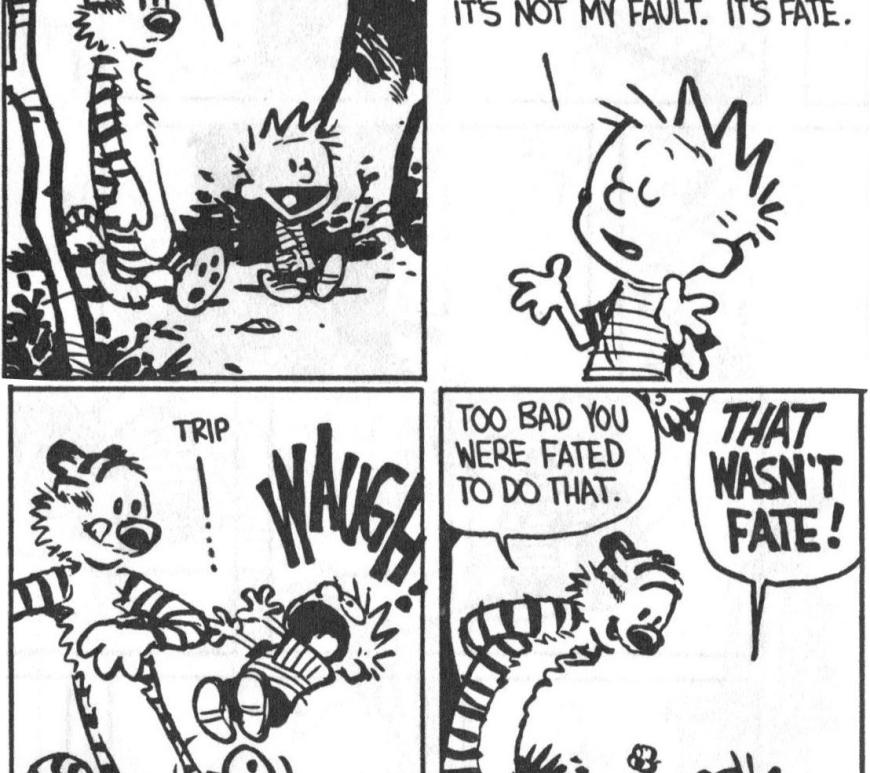
OK, so let’s talk about free will. I’ve had several people ask me to explain my understanding of it lately, so apparently it’s a subject of interest. As the conversation usually breaks out, you have free will on one side and determinism on the other. Free will says we make our own choices. Determinism says that everything is decided for us. Free will is a … Continue reading Free Will and Its Discontents

Bring the Smelling Salts and Set Your Alarm Clocks!

So there’s this lovely woman named Judy who produces the radio show Up For Debate with Julie Roys on Moody Radio. And I think she might be slightly incompetent. I mean, I’m no expert in these things and I certainly can’t predict the future, but it seems likely that come Monday morning she’s going to be having a serious conversation with someone higher up about whether she has the judgment required to perform her duties. Why do I say this, you ask? Because the poor dear went and asked yours truly to be part of an hour long discussion on the church, race and Ferguson. And I, having a big mouth, lots of opinions and no qualms about taking advantage of dear Judy’s foolishness, said yes.

So, if you’d like to hear me engage in my usual tomfoolery (hopefully without the typos, grammar glitches and random gibberish that I like to sprinkle in my writing), tune in. It’s on Moody Radio from 8-9 am, central time, tomorrow morning. Program info and station information can be found here. And if you really love me, call in and gush about how amazing I am and how every good Christian should listen to everything I say. Depending on how it goes, I might need the help!

In all seriousness, say a prayer for me. Continue reading “Bring the Smelling Salts and Set Your Alarm Clocks!”

Sticky post

And Now For Something Weird in the End Times

In today’s edition of signs of the end times, we’re going to talk about vanity, the anitchrist, lion’s teeth and Marian apparitions. Among other things. Because part of my calling is to make your brains hurt. But don’t worry, it’ll be fun! And fun is good until somebody pokes an eye out. But I promise I’ll be careful not to poke your eye out. So, … Continue reading And Now For Something Weird in the End Times

Oppression, Starvation and Christ

The hallmark of an oppressive system is that it benefits some people while harming others. Because the system does provide benefits to some people, many believe that the system is fundamentally good. The fact that the system harms some people is attributed not to the oppressive nature of the system, but to the failures of the people who are being harmed. This has the effect of shoring up support for the system, even among those who are harmed by it because to admit that you are suffering is to admit your own unworthiness. Any evidence of harm being done by the system becomes evidence that the system is required to protect what is good about the system from those who are unworthy.

Those who are unable to hide the extent to which they are suffering are unlikely to stand up for themselves, because as members of the human race, they inevitably will have faults and failures. Sometimes they themselves believe the narrative which says they are to blame for their own suffering. Other times they are resigned to suffering in silence, knowing that however unjust it may be, their faults and failures will be used to condemn them and dismiss their complaints against the system.

We see a prototypical example of this sort of oppressive system at work in the book of Job. Job’s friends believe that suffering is caused by sin, that this is as it should be, and that Job’s suffering must therefore be the result of some secret sin on Job’s part. In the story of Job, we see that this is not the case. Job was specifically identified as a good man and God himself rebuked Job’s friends for suggesting otherwise. However, rather than understanding God to be rejecting the oppressive habit of blaming suffering on sin, we tend to read this as the story of a man who was an exception to the rule that you get what you deserve in life. A caution against relying on the system to excess rather than a denunciation of the system entirely.

At the other end, oppressive systems claim that those at the top are owed a larger portion of the benefits from the system because they are simultaneously very good and very bad. They are very good in that they are smarter, more ambitious, more fierce, closer to the divine and capable of wielding more power than the rest. They are very bad because if they are not amply rewarded, they will not use those abilities for the good of others. Their demands are allowed to grow, unbounded by anything outside of themselves as the people who support the system trust them to provide for their wellbeing, provided their demands are adequately satisfied.

An oppressive system always relies on an idol at the very top in order to operate. The idol allows the men who benefit from the oppressive system to lay claim to their right to power as the result of being the living embodiment of the idol. An idol may be a god or spirit, such as the ancient pagan gods or anthropomorphic spirits of the earth even ancestor worship. Or it may be an idea about the proper ordering of humanity such as in monarchies, gender roles or caste systems. Or the idol may be a virtue which is elevated above all others such as intelligence, ambition or strength.

Idols, of course, are by definition false gods, unworthy of worship and unable to provide what they promise. The systems which grow out of them are inevitably oppressive, providing benefits to some while leaving others to suffer. Frequently this suffering is incurred in service to the system itself such as those who sacrifice their children to idols or who work themselves into an early grave providing for families they barely know.

While many today view Jesus as either harmless or an advocate for the system de jour, in reality, Jesus subverts every oppressive system. He demonstrates that only God is worthy of the devotion we humans habitually give to idols. Unlike the idol, which is functionally viewed as simultaneously very good and very bad, Jesus shows us the face of a God who is good in all his ways. He does not provide for us according to our fealty, but causes the rain to fall and the sun to shine on all the same. Rather than demanding disproportionate benefits in recognition of his worth and power, God demonstrates his worth and power by giving up all benefits and sharing in the lowest human’s suffering. Continue reading “Oppression, Starvation and Christ”

Of Camels and Gnats

Gnats are annoying. Biting gnats leave welts that are much itchier than mosquito bites and when they swarm, you’re likely to wind up looking like an idiot flailing your arms around in a futile attempt to keep them away. Not to mention that you’ll inevitably end up inhaling or swallowing one on accident. For the next hour you’ll feel like there’s something disgusting stuck in your throat or nasal passages. As small as they are, gnats aren’t the sorts of things you live peaceably with.

So you can imagine that back in the days when camels were a normal mode of transportation, if you hired a camel to carry you and your goods on a long trip, and your guide showed up with a gnat infested camel, this would be an issue. A long trip on a gnat infested camel was probably a known cause of nervous breakdowns in the ancient world. So, of course, you would demand that the guide you hired for the trip do something about the problem. Attach fly paper to the camel’s ears and provide you with a climate controlled helmet to wear on the trip or something.

Now, a camel has a thicker hide than a human. But a serious gnat infestation isn’t fun for a camel to endure. Particularly since the little devils will target soft spots like the nose, eyes, mouth and other more unmentionable areas on a camel. Camels aren’t particularly know for their sweet dispositions anyways. So it’s easy to imagine that a gnat infested camel may be a particularly ill tempered beast.

In fact, while you are busy figuring out what to do about the gnats. the people tending to and attempting to load and prepare the camel are liable to get bit, spit on, kicked in the head, crapped on and otherwise injured by the camel. Imagine for a moment if you responded to the various cries and complaints of the people the camel is hurting by telling them to be more careful in doing their job, to stop with all the complaining. Maybe you fire the person who had the gall to come to work covered in camel dung.

Or maybe you’re not quite that insensitive so you say, “once we get this gnat situation worked out, the camel will settle down and you’ll be fine. But right now I need you to shut up so I can deal with this gnat problem.”

Or if you fancy yourself as a sensitive person who understands the plight of dealing with a gnat infested camel, you might say, “the camel kicked you in the head? That’s awful. I know what it’s like. You should see the bites I got while I was sitting on it. I feel your pain. In fact, you really ought to be over here tending to my welts instead of laying on the ground moaning like that.”

It seems to me that as a people, this is exactly how the problems we face play out. We are so fixated on the problems of those who are riding the camel that we end up not tending to the injuries inflicted on less powerful people who have been injured by the camel. Continue reading “Of Camels and Gnats”

Why the White Dude Crossed the Tracks

Back when I did prison ministry, we used to have this crazy old white dude who would come in to talk with the boys. He had a ministry working with gangs on the streets of Chicago. He had occasionally even managed to bring high up people representing large, dangerous gangs together to reach agreements which would reduce the levels of conflict, and therefore the levels of violence between them.

Youth for Christ, a national organization which includes Campus Life, City Life, and Juvenile Justice Mission, provided funding for his ministry by employing him between 1982 through 2008. Which is a really long, long time to be a youth minister. Most burnout within their first decade.

At the time I was involved with prison ministry, crime had just reached a 20 year high, and the problem was most acute in urban areas like Chicago with high density, segregated housing. There were some places that police avoided patrolling out of fear of being targeted by violence, so his ability to develop relationships and gain trust among the gangs was the subject of a lot of interest.

He was invited to speak to kids in prisons all over Northern Illinois and served as a youth chaplain for the Cook County Sheriff’s department. He made sure that at every step along the path a vulnerable kid was taking, he was there to tell them about Christ’s love.

The man’s name was Gordon and he looked like a comedy version of a used car sales man. Wore ill fitting and mismatched business clothes. Had a BAD comb over. He was in his late fifties when I met him. But I was 18 at the time, so he could have been my grandpa. If my grandpa were a used car sales man in the early 80s. Gordon had a way of talking that was slightly disjointed, but jokey enough that he kept his audience engaged. He came off as a bit of a fool, really.

But it was all very deliberate. Continue reading “Why the White Dude Crossed the Tracks”