American Dreams

The Barna Group just put out the results of a survey of Americans asking about their ideal life. According to the findings, over 75% of us view the following things as “very important” parts of our ideal life:

Have good health (85%)

Living with a high degree of integrity (85%)

Having one marriage partner for life (80%)

Having a clear purpose for living (77%)

Having a close relationship with God (75%)

Having close personal friends (74%)

More than half of Americans also listed “having a comfortable lifestyle (mentioned by 70%), having a satisfying sex life with their marriage partner (66%), having children (66%), living close to family and relatives(63%), being deeply committed to the Christian faith (59%), and making a difference in the world (56%).” At the bottom of the list were achieving fame or public recognition (7%), owning the latest household technology/electronics (11%), owning a large home (18%), working in a high paying job (28%), traveling the world for pleasure (28%).

I can’t help but think when I see something like this that there is a large gap between what people say they want and what they are actually doing with their lives. On one hand, it could be that it’s so easy to say the “right” things to a poll taker. OTOH, I wonder if a big part of the problem is that while people want the right things, they do not have the tools or know-how needed to actually live them out. This is my personal theory.

It reminds me of a question I asked a bunch of people I know a couple of months back: “Do you think that most people want to be good people and are willing to put in the work it would take for them to be good people?” Continue reading “American Dreams”

Activist Judges on Steroids!

Oh my goodness! We’ve all heard complaints about “activist judges”, but this moron in Canada absolutely takes the cake. A judge in Canada has overturned a father’s decision to ground his 12 year old daughter from taking a 3 day school trip because she thought it was “too harsh”. I kid you not. Continue reading “Activist Judges on Steroids!”

The Context of Jeremiah Wright

Over at Christianity Today there’s an article titled “Black Power from the Pulpit” about Jeremiah Wright which places him and black liberation theology in the context of the black church and the message of Christianity. It is actually an interview with Thabiti Anyabwile who wrote the book: The Decline of African American Theology. Mr. Anyabwile is a critic of both black liberation theology and the state of many black churches, without being one of the many jingoists we’ve heard from lately who think saying, “they’re racist” constitutes a legitimate critique. He is speaking from a position of understanding and respecting the history and tradition of the black church as well as the struggles of African Americans. Wouldn’t it have been nice if more people who were disturbed by Rev. Wright’s ranting would have turned to someone with this perspective for their critiques rather than the craptastic nonsense we’ve been subjected to?

At any rate, I recommend reading the article, but here are some of my favorite take-away points:

On the way the controversy played out in the media:

Q: Has anything surprised you about the wave of indignation that has followed news of these sermons?

A: I’ve been surprised that so much effort has been made to saddle Obama with the views of his pastor . . . I’ve also been surprised at how deep the ignorance of the African American church and its preaching tradition goes.

It is interesting that some of those who were particularly upset over Wright’s remarks didn’t initially see them as being racial. They seemed to them to simply be anti-American. Continue reading “The Context of Jeremiah Wright”

“Expelled” Exposed

The National Center for Science Education has put together a website to respond to the new pro-Intelligent Design movie “Expelled: No Intelligence Allowed”. It is called Expelled Exposed. I have to say that red flags were raised for me when I heard a podcast about the movie based on this premise:

Have you ever noticed that Christians are fine with having God and science coexist? In fact, Christians see scientific discoveries as strengthening their faith precisely because they reveal the marvel of the world. So why is it that so many scientists seem to hate the idea of God so much?”

Um, yeah. Loonies like Richard Dawkins aside, suffice it to say that this has not been my experience of the “conflict” between Christians and science. I have already made known my stance on creationism and intelligent design.

Part of my problem with creationism and intelligent design has always been the dishonesty used to sustain the argument against evolution. I suppose it isn’t too surprising to see that this dishonesty isn’t limited misrepresenting main stream science and scientists. It turns out that many of the stories used in the movie to demonstrate this supposed intolerance for alternative views are misrepresentations as well.

For example, one scientist featured in the movie, Richard Sterberg, claimed that after using his position as editor of a small scientific journal to publish a pro-intelligent design article, he was fired from his post as editor, forced out of his office at the Smithsonian, and made to turn in his keys which gave him access to the Smithsonian’s specimin collection which he needed in order to do his work. Turns out that he had put in notice 6 months prior at the journal, had to move offices along with everyone else in his work area as part of an office re-arrangement and needed to turn in his keys so he could be issued a key card that would work with the new security system. Continue reading ““Expelled” Exposed”

Transcending Race and Delusional Conservatives

The candidacy of Barak Obama has inspired a great deal of talk, some of it self-inflicted by Sen. Obama, about the idea of transcending race. However, as the campaign as worn on, it has become apparent that “transcend race” is one of those phrases which means different things to different people. It seems to be a Rorschach test of wishful thinking in which people see it as meaning what they want it to mean.

I want to address how this issue plays out on the conservative side. The conservative perspective is the one which is closer to what I identify with and I think we have suffered as a nation because of conservatives’ refusal to look at and think reasonably about issues of race.

In regards to transcending race, on the conservative side, I have heard a fair amount of talk which indicates a wish for “transcending race” to mean eliminating race as an issue to which we need to pay attention to or offer consideration for. Because of this, conservatives have often reacted to things like the fact that Obama attends an Afrocentric church as a betrayal of his claim to be someone who can help us move past race. However, this perspective is based on a host of completely erroneous ideas.

The first problem with this perspective is that it presumes that in order to “get past race”, we must embrace a sort of “color-blind” nirvana and assiduously pretend that we have already reached such a place. In large part, this seems to mean that we ought to reject anything which conflicts with the idea that we are and should be completely unaware of race. Continue reading “Transcending Race and Delusional Conservatives”

Two Lists

Brian McLaren spoke recently at a conference taking place at Willow Creek Community Church and shared something which I find fascinating. Back in the 1970s, McLaren volunteered as a youth minister. He asked the kids in the group to make a list of what the pressing issues at their churches were. They came up with things like contemporary worship music and speaking in tongues. Then he asked them to make a list of what the pressing issues facing the world were. Their list included typical 1970s concerns like nuclear war, communism and famine. McLaren points out that there was no overlap between the two lists. The problem as he saw it was that as he was leading young people to Christ, they would get drawn into the first list of concerns and become less and less involved in the issues of the wider world.
I think that a lot has changed since the 1970s and churches are starting to do a better job of creating overlap between McLaren’s two lists. In fact, much ink has been spilled observing the rise of a new generation of evangelical leaders who are as interested in social justice and global warming as they are in gay marriage. However, I wonder how much overlap is going on at ground level in churches across the nation between church concerns and world concerns. If you walked into your church’s youth group today and asked the kids for their two lists, would there be overlap? Continue reading “Two Lists”

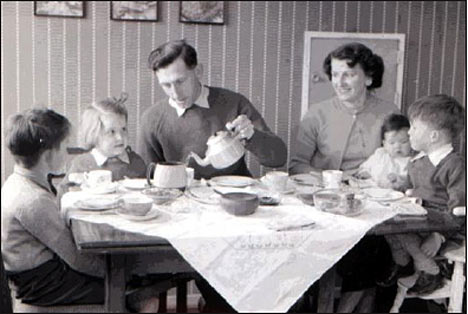
It is family that will change the world

It has been my observation for some time that we have a very bizarre disconnect in our culture between the way we treat our children and the adults they become. On one hand, when we run across an adult with emotional, mental or substance abuse problems and they share the traumas of their childhood, we are sympathetic. We can see the line between neglect, humiliation, abuse, a failure to protect, etc and the problems which this person has as an adult.

On the other hand, we somehow seem to think that children will survive all manner of things from being dumped in a crowded daycare for 12 hours a day at 6 weeks, to watching violent and sexual entertainment, to being bullied at school without any serious damage being done. It’s as if we as a society seem to think that as long as our children are not subject to permanent bodily harm and have adequate exposure to education and enrichment activities, we’ve done our job. There’s no serious consideration given to the sort of people we are raising and the effect that masses of people raised without adequate attention, nurturing, values and compassion will have on our society. Even when we claim to be advocating for kids, we have a hard time connecting the children of today with the adults they will become. We speak of children as the future, as if they were magical beings who can set things right by virtue of compelling the adults around them to behave well so as not to upset the children’s cuteness, not out of concern for the sort of adults they will one day be.

We have compassion for damaged people on the back end while refusing to do anything to stop the activities which cause this damage to begin with. Adults rule, the kids will be alright and families are whatever the adults want them to be. Continue reading “It is family that will change the world”

Black-White Conversations We’re Afraid To Have

Northwestern University just put out a study which found that white people avoid dealing with black people or discussions of race out of fear of doing something which will cause them to be accused of bigotry. This is probably one of those “We need researchers to tell us this?” things.

As many of my readers know, I am married to an African American man, so we’ve had many of those conversations which most white people avoid like the plague. I’ll just say that it’s been interesting.

Over time, I’ve come to see the relationship between white Americans and black Americans as being like a bad marriage. Neither side trusts the other, each attributes the worst possible motivations to anything the other side does, neither is willing to listen to the other but continually demands that their concerns be taken seriously, etc., etc. The solution to a bad marriage generally requires the two parties to stop being so self defensive, listen to each other, avoid responding negatively at all costs, be willing to do the right things for the relationship irregardless of what the other person may or may not do, etc. I believe that it will take the same sorts of actions between white and black Americans to actually move past the distrust and hostility which we generally deal with each other with.

I think that one of the biggest problems with the black-white relationship is that we fail to understand or appreciate how things look from the other’s perspective and then insist on assigning the worst possible motivations to what the other group does (or does not do). I believe that if we are willing to start making a real effort to understand the other group’s perspective (not necessarily agree with – just understand that POV as sincere and real), it would allow us to stop being so defensive and hostile with each other.

I bring this and this study up because my husband recently shared an idea he has about just the sort of “white persons inadvertently messes up, black people go ballistic” interaction which seems to have made white people so nervous that they avoid race at all costs. Continue reading “Black-White Conversations We’re Afraid To Have”