So What Happened to Adam and Eve Anyhow?

Let’s do a quick horticultural lesson here today on the difference between fruits and vegetables. Fruits, technically, are the fleshy, edible part of a plant which contain seeds. They are produced by plants that flower as a means of reproduction. Vegetables, on the other hand, are plants which are themselves used in part or whole as food. So, for example broccoli is a vegetable because we eat the stems and immature flower buds of the plant. Tomatoes are fruit because they contain the seeds of the plant they grown off of. Lettuce is a vegetable because we eat the leaves of the plant. Apples are fruit because they are the seed bearing part of the plant which grow after the pollination of the tree’s flowers. Get the idea?

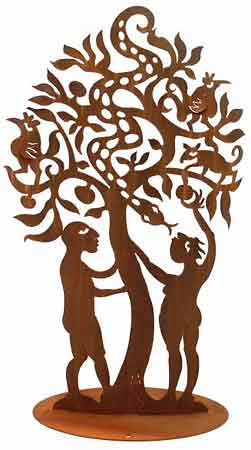
The reason I bring this up is because there’s a little detail which is often missed in the story of the fall which is actually, very, very important should we wish to understand what happened. You see, God forbid eating the fruit of the tree of the knowledge of good and evil. The fruit is what a plant produces – not the plant itself. Fruit is the end result of a process of blooming, pollination and growth. What God was forbidding wasn’t the knowledge of good and evil, but the end result of it – the fruit of that knowledge.

(Before going any further, if you haven’t already, you will need to read the previous posts on the fall or nothing I say below will make ANY sense. They are:

Why Was the Tree of the Knowledge of Good and Evil in the Garden?

The Fall Wasn’t Our Fault

Does God Sit Around Monitoring Our Thoughts? And Other Pertinent Questions

Don’t worry. They’re short, We can wait.)

You will perhaps recall that when speaking to the serpent, Eve said that God had also forbidden touching the tree of the knowledge of good and evil. We don’t know if she was mistaken and actually thought she wasn’t allowed to touch the tree or if she was exaggerating to make her point to the serpent. But either way, I think it’s fair to surmise that Adam and Eve were unfamiliar with the tree. Which means that when they ate of the fruit of the tree, they got the results of the knowledge of good and evil without having even started the process which normally leads up to the having fruit to eat.

The text says that Eve saw that the fruit was useful for gaining wisdom. Wisdom is when you use knowledge and understanding to guide your actions, thoughts and choices. Eating the fruit was useful for gaining wisdom – it gave the person who ate it the chance to live as one who knows good and evil – ie is able to put their knowledge into action. Only Adam and Eve had no knowledge. And without knowledge, the only way to learn wisdom is by screwing up and learning from it. The difference between how the fruit was meant to be used to gain wisdom and what happened to Adam and Eve is like the difference between dropping a newly minted navy seal off in the middle of the jungle with only a what he could fit into his pack to survive on and dropping a kidnapped child off in the jungle with a notebook, two pencils and a fruit roll-up in their Barbie backpack. Continue reading “So What Happened to Adam and Eve Anyhow?”

Does God Sit Around Monitoring Our Thoughts? And Other Pertinent Questions

Are there any limits on suffering? Does God sit around monitoring our thought? Does God know everything that’s going to happen before it happens? These are some big questions which I’m going to be tackling today. But first, if you haven’t already, you really do need to go read my last two posts so you won’t be totally confused:

Why Was The Tree of the Knowledge of Good and Evil in the Garden?

The Fall Wasn’t Our Fault

Don’t worry – they’re all short. This post will still be here when you get done.

‘Kay? All caught up? Alrighty, then. So, I’ve been talking about the story of the fall for the last couple of days. But for the moment, I want to rewind a bit and go back to Genesis 2. In that chapter, God brings the animals to Adam to be named. Words are powerful things – “In the beginning was the Word . . . Through him all things were made.” Naming has been seen in many cultures and in many times as an act with great mythological and symbolic power. And God gave the power to name and label the creatures of his own creation over to the man. This is the act of a God who is willing to allow for the unpredictable and in not threatened by what he doesn’t direct.

One of the grand arguments of Christianity is whether God knows exactly what is going to happen at all times or if events can be unexpected and unpredictable. I wrote yesterday and in another post on time that I think that there is a difference between God as he exists outside of time and God as he acts within the flow of material creation and time. Outside of time, all that is and will be and ever was exists together and God is complete, whole and unchanging. Within the material world where time exists, God is in dynamic relationship with his creation which does act and unfold in unexpected and unpredictable ways. In fact, I believe that God enjoys this aspect of creation. I think it gives creation an almost game-like quality and allows for true relationship. When God handed the naming of the animals over to Adam, God lost nothing. God does not have our dysfunctional need for control and predictability. He is sovereign all on his own to the point of being able to hand the naming of the animals off to humanity.

I bring all of that up because one of the questions raised about what I’ve been sharing regarding the story of the fall is whether God knew it was going to happen. It was made very clear to me that the answer is no. Not only was it not part of his plan, it was not something which had been anticipated. As I explained yesterday, the accuser had a role to play in God’s kingdom but it in no way required inviting children into an adult game. Continue reading “Does God Sit Around Monitoring Our Thoughts? And Other Pertinent Questions”

The Fall Wasn’t Our Fault

So yesterday, we left young Adam and Eve standing next to the tree of the knowledge of good and evil. As I explained, I was told/shown that the tree was to Adam and Eve what the adult world is to a child. Rather than being a temptation or even a danger, it was a good thing which let them know that there is more to life than their childish existence. God told them not to eat from that tree because the experiences of the adult world are not for children to have – adult experiences being the fruit they were not to eat. Under normal circumstances, the existence and close proximity of the adult world does not pose a threat to children, nor is it particularly tempting. Unless one of the adults does something to bring a child into the adult world inappropriately. Enter the serpent.

It has often been pointed out that the serpent isn’t specifically identified with the character of Satan in this story. However, the serpent was indeed Satan (whatever or whomever Satan is in reality). The connection between the serpent and Satan is made in several places in scripture – particularly in Revelation 12 and Revelation 22. But even more damning is that both the serpent and the character of Satan work in the same way. Satan is a Hebrew word meaning accuser or adversary. In Revelation 12:11, the serpent is described as “the accuser of our brothers and sisters, who accuses them before our God day and night”.

Satan’s job is to serve as an adversary. He does this through accusations. Which is to say that Satan calls the goodness of God, creation and humanity into question by offering alternative explanations for what is going on. So at the opening of the book of Job, we get the accusation that Job isn’t faithful because he loves God, but because God has protected him. When Job remains faithful after losing everything, Satan claims it is only because Job has not suffered physical harm himself. This is what Satan does – looks for any explanation possible to explain away what is good, true, faithful and loving. When Satan tempts Jesus at the end of his 40 days in the wilderness, he uses scriptures to argue that things which are forbidden – grasping power, testing God, etc – are in fact scripturally sanctioned. He offers an alternative vision of reality which Jesus rejects.

The thing is that Satan had a legitimate role in God’s kingdom. One of the ways to view the existence of the material world is that it is God exploring and expressing the reality of himself through this physical creation. I’m probably going to flub this explanation, but outside of the created world, God exists as whole, complete and unchanging. Within the created world, God can unpack all of that and share himself with us, his creation. One of the ways which we can know and understand something is by seeing how it is and isn’t like something else. God is light – in him there is no darkness. But without darkness, how can the light be known? If there is only undifferentiated light, nothing can be seen or observed. And this is the purpose which Satan serves. He introduces the dark by which the light can become known. Continue reading “The Fall Wasn’t Our Fault”

Why Was the Tree of the Knowledge of Good and Evil in the Garden?

Hi, I’m Rebecca and I’d just like to say at the outset that to the best of my knowledge I’m not actually crazy. And no drugs were involved in the making of this post. Of course, the only reason for someone to start by declaring themselves sane and not drug addled is because they are about to say something which will make people think otherwise. Which is what I’m about to do.

But first, a little background. Perhaps you recall me saying a few times that I have a bit of a fixation on the creation stories. I rejected a literal reading of them ages ago. A supposedly literal reading is incompatible both with the evidence from God’s creation and the text itself. I don’t honestly know if the stories are a figurative retelling of things that actually happened. Or if they are true myths in the sense that they are not true because they actually happened, but true because they happen all of the time. Probably as far as I would go is to say that they tell the story of a deep spiritual reality which has been made manifest in the material world.

I think that the creation stories are important because they are our faith’s explanation for the start of all things concerning us. They give us a peek at our true identity, who we were made to be, what our relationship with creation is, how God works and ultimately, hold the key to figuring out what is wrong with us. That last bit seems particularly important to me, as it is very hard to fix something if you don’t know what is wrong with it.

Over the last 20 years I have spent what probably amounts to an absurd amount of time meditating on and trying to puzzle out the creation stories. There are two things I have learned which are particularly relevant to our discussion here today. The first is that the garden was a place for Adam and Eve live and learn. It was almost like a playground for them in the sense that for a child, the whole world is a playground. Like a playground, the primary purpose of the garden was for Adam and Eve to have fun, but also to develop skills. And like a playground, it probably wasn’t entirely safe, but life with no risk isn’t really the sort of setting which mankind tends to thrive in. Too much is bad, of course, but too little is stunting.

The other thing I have learned is that Adam and Eve were children. Remember the other day when I explained that adam actually means mankind and that when God made and dealt with Adam, he was dealing with mankind? Well, just like each individual person is born needing time to grow up into maturity, mankind is likewise in the process of growing up. There has been a tendency to assume that Adam and Eve were just like us, only without sin. However, Adam and Eve were just like us the same way that 3 year old me was just like me today. I’m still me, and I may or may not have actually improved since them. But inevitably I’ve grown and changed a good deal between 3 and 39. Continue reading “Why Was the Tree of the Knowledge of Good and Evil in the Garden?”

Moving From “Me” to “We”

If you are an American Christian, odds are really, really good that at some point you have been told that as you read scripture, you should try inserting your name for the word “you” in parts of scripture where Israel or God’s people are being addressed. So, I could read, “Rebecca shall be a crown of beauty in the hand of the LORD, and a royal diadem in the hand of her God. No longer will they call Rebecca Deserted, or name her land Desolate. But Rebecca will be called Hephzibah, and her land Beulah; for the LORD will take delight in Rebecca, and her land will be married.” (Isaiah 62:4) It’s not a terrible idea; sometimes we do need help personalizing scriptures and realizing that the love expressed applies to ourselves. Of course, if you do this, eventually you will end up with something like “Rebecca also took her beautiful jewels made of My gold and of My silver, which I had given her, and made for herself male images that she might play the harlot with them.” (Ezekial 16:17) Which is a little too personal maybe.

Now, if your pastors/teachers are any good at all, they have probably also taught you that in nearly all of the places where God speaks to “you” or even where Paul and Jesus address “you”, unless a specific person is being addressed, the word used indicates a plural you. So it’s more of a “y’all” than “you, Rebecca, sitting over there eating jelly beans.” This ought to be obvious as usually the word “you” is being used to address the nation of Israel or an entire church or the group of people being spoken to. But we Americans are notoriously hyper-individualistic. So with or without a anyone’s encouragement, we do tend to read scripture as if it were speaking to us individuals rather than to a collective group.

A while back, I became convicted that the hyper-individualistic programming of our culture isn’t compatible with Christianity. I matter as an individual, but I am also part of a larger body. My life is not for me alone, but for the good of God’s Kingdom – a Kingdom which encompasses all of creation. If I see my life and my faith as primarily about me, I am very much mistaken.

What I came to realize is that countering hyper-individualism isn’t just a matter of prioritizing social justice or even church fellowship. Rather hyper-individualism hides very deep truths about our identities, our purpose and even the meaning of our lives from us. Because the truth is that my life isn’t about “me”. My life and your life and the life of every other human on the planet is about “we”.

Now, that might sound like some new-agey, mumbo-jumbo, but it’s actually very deeply embedded in scripture. Continue reading “Moving From “Me” to “We””

Worst Clobber Verse EVER – Christian Patriarchy Edition

In a more perfect world, the title of this post would be complete jibberish to all of my lovely readers. But alas, we live in a world which is in the process of being redeemed, so some of you know all too well about Christian Patriarchy and clobber verses. However – joy of joys! – we live in a world which is in the process of being redeemed and I know that some of you have no idea what Christian Patriarchy or clobber verses are. So, for the blissfully uninitiated, allow I to explain a bit.

At its simplest, Christian Patriarchy is the teaching that there is a God ordained hierarchy in which men are over women and children. A daughter is under her father’s headship until she marries and responsibility for her is transfered to her husband. Ideally in this arrangement, the man is responsible for protecting his wife and daughter from other men as well as providing for her and overseeing her spiritual, moral and personal development. In exchange for this protection and leadership, a female treats her father/husband with respect, obedience and deference. Although this arrangement has been propagated around the world and throughout time irregardless of religion, Christian Patriarchy proponents insist that this is a Christian arrangement rather than just something people have had a tendency to do. Like going to war or practicing dietary restrictions.

A clobber verse is a verse of scripture which is used to provide definitive proof – in the mind of the person using it – that a particular idea or teaching is true, biblical and theologically unassailable. Now I have a few verses which I will use this way all day, everyday. “God is love” for example. What makes a clobber verse a clobber verse is that inevitably, they are pulled completely out of the context they were spoken into. Nearly always, on closer examination the verse in question doesn’t even say what the person using it seems to think it is saying.

Continue reading “Worst Clobber Verse EVER – Christian Patriarchy Edition”

How I Read Scripture

Want to see me turn into a psycho raving wiotch? Say something like this to me: “if the book of Genesis – particularly the creation – isn’t a historical record of what actually happened, then the bible isn’t trust worthy and our faith is meaningless.” Seriously – I made myself stop engaging in online discussions about creation because I am incapable of behaving like a decent human being, much less like a good Christian, when confronted with crap like that. In fact, just recently I broke my rule and ended up telling someone that the “god” he served – who is so weak and pathetic that he can be toppled by some labcoats and DNA – was a worthless piece of filth that wasn’t worthy of being squashed under the feet of the mighty God of the universe that I know. Which while true, may not have been the best demonstration of Christian tolerance and charity that I’ve ever displayed. So now you know why I normally don’t allow myself to partake of such discussions.

But for a lot of people who were taught some version of what is called inerrancy in certain Christian circles, the question does remain – how should we be reading and understanding the bible if not as the factually accurate Word of God, completely free from error or inconsistency? In the last few days, I’ve read a few other people’s explanations for how they deal with the hard parts of scripture or the parts which are in conflict with one another. Mostly the answers seemed to be that if there was a passage which portrayed God in what we’d consider a bad light, they would balance that passage against other passages which contradicted and decide that those took precedence over the negative passage. Or sometimes they would simply view a passage or story as an anachronism – a reflection of the cultural assumptions of the people at the time which was basically put in for their own benefit and not ours. Honestly, the answers I’ve read seem a bit like confirmation of the accusation that people simply pick and choose which parts of scripture to accept as true. So, I thought I’d share my own particular way of dealing with scripture with y’all.

Thankfully, by the time I had been exposed to the idea of inerrancy, I had already read the bible a time or two so I knew enough to take it with a grain of salt. However, I truly hope that it is clear from my writing that I do, in fact, hold the bible in very high regard. It would be hard for me to put into words just how important the bible is to me and the actual love I have for it. Which given the fact that I’m a writer who is seldom at a loss for words is saying a great deal. And I don’t feel free to ignore or dismiss parts of scripture because I don’t like or agree with them. Instead, I actually have a pretty well developed approach for understanding scripture and dealing with the difficult parts which I will try to explain briefly below.

First, I understand that unlike Muslims with the Koran or even Mormons and the Book of Mormon, Christians and Jews have always understood that our scripture was not dictated directly by God. Rather, it has always been considered to be inspired by God and written by men. Which means that it reflects both the input of God and man. A lot of people make the mistake of thinking that the scripture is God’s story alone – that anything which is not completely consistent with the reality and truth of God is absent from it. However, the scripture is rather clearly not just the story of God, but also the story of man. Continue reading “How I Read Scripture”

Is Reading Scriptures Literally, Literally Wrong?*

I came across a blog post by Father Stephen, an Orthodox priest about the problems with taking scriptures literally. On this blog, I have tended to focus on how insisting on taking scriptures literally leaves us vulnerable to being unable or unwilling to deal with reality or to losing our faith altogether when our literal understanding comes into conflict with reality. Father Stephen points out another, probably more important problem with a literal approach to scriptures: it engenders a shallow reading of scripture. From his post:

The Scriptures, particularly those of the Old Testament, are frequently misread (from a classical Christian point of view) in a literal manner, on the simple evidence that the New Testament does not read the Old Testament in such a manner. Rather, as is clearly taught by Christ Himself, the Old Testament is “re-read” from a Christological point-of-view. Thus Jonah-in-the-belly-of-the-whale is read by the Church as Christ in Hades. The first Adam in the Garden is but a shadow and antitype of the Second Adam – the One who truly fulfills existence in the “image and likeness” of God. The Passover and the deliverance from Egypt are read as icons of the true Passover, Christ’s Pascha and the deliverance of all creation from its bondage to death and decay. Such a list could be lengthened until the whole of the Old Testament is retold in meanings that reveal Christ, or rather are revealed by Christ in His coming. . .

A “literal” reading of the Old Testament would never yield such a treasure. Instead, it becomes flattened, and rewoven into an historical rendering of Christ’s story in which creative inventions such as “Dispensationalism” are required in order to make all the pieces fit into a single, literal narrative. Such a rendering has created as well a cardboard target for modern historical-critical studies, which delights itself only in poking holes in absurdities created by such a flattened reading.”

Now, I do know that it is possible to see the deeper Christological meaning of the scripture stories while also maintaining a belief that these things are literally historical events, recorded in scriptures. And certainly there are certain things which we need to be literally true. For example, Paul says in 1 Corinthians 15:17 And if Christ has not been raised, your faith is futile; you are still in your sins.”

However, I think that Father Stephen is right that by seeing much of scripture as a record of events which can be shaped into a literal narrative, there is a strong tendency to “flatten” scriptures into nothing more than an account of historical events. Continue reading “Is Reading Scriptures Literally, Literally Wrong?*”

Why We Christians Suck at Loving

Is there something about Christianity itself which leads to the sort of oppression which its adherents have too often been guilty of? You know – the inquisitions, colonialism, slavery, pretty much every interaction we ever had with First Nations people in the Americas. To name a few. The standard answer for western theologians is that the Christian faith and its teachings are not the problem – people’s sinful natures are. It’s the, “well those aren’t real Christians” blow off. However, South Korean theologian Andrew Sung Park posits a more honest – and more helpful – answer to this thorny issue of the convergence of Christianity and oppression. The problem as Sung Park sees it is that we westerners see Christianity as the answer to the problem of the sinner. All have sinned and fallen short of the glory of God, so Jesus came and died for our sins so we can be forgiven and all that. Our theology, Sung Park argues, elevates the needs and concerns of the sinner over the needs and concerns of the people sinned against. And therein lies the problem.
This may seem akin to blasphemy for many Christians for whom the problem of sin and sinners is THE message of Christianity. However, compare our sinner-centered approach to Christianity to the words which Jesus actually spoke.When Jesus started his ministry, this was the text he chose:

“The Spirit of the Lord is on me,because he has anointed me to preach good news to the poor.He has sent me to proclaim freedom for the prisoners and recovery of sight for the blind,to release the oppressed,to proclaim the year of the Lord’s favor.” ~ Luke 4:18-19

Jesus’ most famous sermon – the one which many scholars believe was his “stump speech” – the oratory he gave when he traveled to a new place and crowds gathered to hear him centered on this:

Continue reading “Why We Christians Suck at Loving”

Psalm 73 ~ A Meditation for the Weary, Bitter, Stumbling Soul

These were the words I needed this week:

Psalm 73

Surely God is good to Israel,
To those who are pure in heart!

But as for me, my feet came close to stumbling,
My steps had almost slipped.

For I was envious of the arrogant
As I saw the prosperity of the wicked.

For there are no pains in their death,
And their body is fat.

They are not in trouble as other men,
Nor are they plagued like mankind. . .

They mock and wickedly speak of oppression;
They speak from on high.

They have set their mouth against the heavens,
And their tongue parades through the earth.

Therefore his people return to this place,
And waters of abundance are drunk by them.

They say, “How does God know?
And is there knowledge with the Most High?”

Behold, these are the wicked;
And always at ease, they have increased in wealth.

Surely in vain I have kept my heart pure
And washed my hands in innocence;

For I have been stricken all day long
And chastened every morning.

I haven’t made a secret of the fact that I’ve been on a wretched and miserable path for a long time now. But what I’ve been a bit more reticent in sharing is that seemingly at every turn, there have been people just waiting to condemn me for my wretchedness. Those who did evil to me would criticize me for walking down paths they had helped to push me onto. Those who turned me out when I was weak would point to my homelessness to condemn me. Those who cut refused to have me around would express shock at the company I was able to keep. Those whose actions crippled me complained bitterly that I was lame and slow no matter how good my work was or how remarkable my healing had been. When I would point to God as the northern star I was following, the response was just like in this psalm: “what does God know? Is he going to pay your bills or fix your car or mend your relationships? Forget God – look at the mess you’re in!” Continue reading “Psalm 73 ~ A Meditation for the Weary, Bitter, Stumbling Soul”